Ghanaian musician Stonebwoy has challenged the negative perception of Ashaiman, insisting that he has no reason to hide his hometown despite the stereotypes and stigma sometimes associated with the community.
The musician said he deliberately uses his international platform and music to project a different image of Ashaiman, arguing that the area should not be defined solely by reports and perceptions of hooliganism.
Speaking at the 2026 Youth Against Corruption (YAC) Summit in Accra, Stonebwoy explained that his pride in Ashaiman was deeply connected to his identity and his desire to give residents something positive to associate with their community.
The musician, whose real name is Livingstone Etse Satekla, recalled performing on a major stage in Ashaiman when it was raining and thousands of residents had gathered to watch him.
He said the experience inspired his song If I Die Today, which reflected his desire to leave behind a legacy that would make his community proud.
"I was on stage and it was raining, and there were thousands of people, and the song just came into my spirit that if I die today, I'm a hero," he recounted.
Stonebwoy explained that the song was also inspired by his determination to challenge the perception that Ashaiman was known only for hooliganism.
"And till today I have tried to showcase the fact that Ashaiman is not only known for hooliganism but also for those who are good people," he said.
He said his music and international appearances had helped change how some people viewed the community, giving residents greater confidence in their hometown.
He recalled an encounter with a director in a high-ranking office who told him about seeing his name and the Ashaiman connection while abroad.
According to Stonebwoy, the encounter made him realise that his work had created something people from his hometown could identify with and take pride in.
He also criticised the tendency of some people from Ashaiman to identify themselves with other neighbourhoods, including Community 13, or Lebanon, because they felt uncomfortable disclosing their actual roots.
He insisted that people should not feel pressured to conceal where they come from simply because of how others perceive their community.
"Me, I don't know why I wouldn't say I'm from Ashaiman. If you don't like me because I'm from Ashaiman, sorry," he said.
Stonebwoy added that people should judge others by their character and conduct rather than the communities they come from.
"When you check my character, check my demeanour. I realise that I'm a good person," he stated.
His remarks formed part of a wider address on patriotism, integrity and national identity, during which he urged young people to take pride in Ghana and the communities that shaped them.
He said his music was deliberately positioned to project Ghanaian identity, adding that whenever he performed, he made an effort to represent the country through his work.
"For me, one of the things that I look up to is when I see the Ghana colours; something goes through my heart," he said.
He explained that the Ghanaian identity he seeks to promote through music was part of the legacy he hoped to leave behind.
Stonebwoy's remarks came at the maiden Youth Against Corruption Summit organised by the Office of the Special Prosecutor on November 26, 2026. The event brought together more than 500 participants to discuss ethical leadership and the responsibility of young people in building a society anchored in integrity.
For the musician, patriotism begins with accepting one's identity and refusing to allow negative public perceptions to determine how one represents their community.
EA
Entertainment of Sunday, 29 November 2026
Source: www.ghanaweb.com
'If you hate me because I'm from Ashaiman, sorry' – Stonebwoy
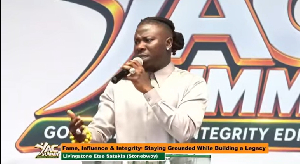 Stonebwoy at the 2026 Youth Against Corruption (YAC) Summit