Ghanaian musician Livingstone Etse Satekla, popularly known as Stonebwoy, has criticised what he describes as a culture that rewards dishonesty while making it difficult for people who uphold integrity to succeed, warning that patriotism cannot flourish in such an environment.
Speaking at the 2026 Youth Against Corruption (YAC) Summit, Stonebwoy questioned how young Ghanaians could be expected to put the country first when people who cut corners appear to prosper while those who stand by their principles are left to bear the consequences.
“Patriotism cannot thrive where integrity is punished and dishonesty rewarded. How can we expect citizens to put Ghana first, do the right thing and protect the national interest when those who cut corners prosper, wrongdoing is excused and people of integrity are left to bear the cost alone?” he asked.
The musician made the remarks at the summit, held under the theme, Building a Generation of Ethical Leaders, where he called for a more practical approach to fighting corruption and promoting ethical leadership.
He argued that discussions about integrity would mean little if people who chose to do the right thing received no support or recognition for their decisions.
Stonebwoy said his experiences with influential people in society had sometimes left him questioning whether integrity was genuinely valued, particularly when individuals with the means and authority to effect change appeared unable to secure support for what was right.
He also challenged participants to be honest about their willingness to remain in Ghana if given the opportunity to relocate.
“How many of us would love to leave Ghana given the opportunity? Be fair, be just, be honest. Nobody will judge you if you say you want to talk for yourself,” he said.
Although he reaffirmed his support for the fight against corruption, Stonebwoy warned against treating anti-corruption campaigns as events people attend merely to listen to speeches.
He proposed the introduction of a reward system to recognise individuals who demonstrate integrity, arguing that people should not be made to feel foolish for putting their country's interests ahead of personal gain.
“For us who love the fact that we have our country's interest at heart, I want to know, can we as leaders here find a way? Because it is like when you are patriotic, you become a fool. Your friend may even laugh at you for being patriotic,” he said.
The award-winning musician also drew attention to the ethical responsibilities that come with influence, particularly for public figures whose decisions and commercial associations can shape the behaviour of younger audiences.
He argued that people must look beyond what is legally permissible and consider the wider consequences of their actions, especially when their choices could influence children and young people.
For Stonebwoy, patriotism is also about how individuals represent their communities and country, a responsibility he said has shaped his music and public life.
He cited his connection to Ashaiman, where he grew up, as an example of how personal pride and a sense of responsibility can change public perceptions of a community.
Recalling the inspiration behind his song If I Die Today, the musician said the idea came to him while performing on a large stage in Ashaiman during a rainy night, with thousands of people in attendance.
He said he wanted to challenge the negative perception of Ashaiman, which is often associated with hooliganism, by showing that the community also produces people with positive values and achievements.
Stonebwoy said he was particularly proud that people had embraced the phrase “Ashaiman to the world”, adding that he had encountered individuals abroad who expressed pride in the community because of his representation of it.
He questioned why some people from Ashaiman felt uncomfortable identifying with the area, insisting that one's place of origin should not be a source of embarrassment.
“I don't know why I wouldn't say I'm from Ashaiman. If you don't like me because I'm from Ashaiman, sorry, then you have to check it properly. And when you check my character, check my demeanour. I realise that I'm a good person,” he said.
The musician further urged young people to pursue excellence despite personal difficulties, recalling the challenges he had faced before establishing himself in the music industry.
He said lessons from his primary school teachers had remained important to him and helped shape his determination to make a difference through his work.
Stonebwoy also referred to Ghanaian amputee footballers who have represented the country, saying their determination to compete for the nation despite difficult personal circumstances should encourage others to put Ghana first.
He recounted the story of a goalkeeper who had previously worked in a factory and played football part-time before losing a hand in an industrial accident.
For him, the experiences of such individuals show that personal challenges should not become an excuse for abandoning responsibility to the country.
“Regardless of the challenges that we have, let us put Ghana first. It is important. It is the same Ghana that our forefathers died for,” he said.
Turning his attention to social media culture, Stonebwoy cautioned young people against measuring success solely by material possessions, including the number of cars or houses they own.
He said the growing pressure to display wealth and live up to unrealistic expectations could encourage shortcuts and weaken the values needed to build a responsible society.
Instead, he urged young people to respect the process of building a successful life, insisting that the experiences and discipline acquired along the way help shape a person's character.
“As my senior brother said, we have to go through the process because the process defines and shapes you. So please, let us uphold some integrity. Let us also have some ethics,” he added.
The YAC Summit 2026 was organised by the Office of the Special Prosecutor (OSP) as part of efforts to encourage young people to take an active role in promoting transparency, accountability and ethical conduct.
The maiden summit, held on November 25, 2026, at the Ecobank Head Office in Accra, brought together more than 500 participants, including students, youth leaders, civil society representatives, public officials, legal practitioners and professionals.
The OSP said the initiative is intended to take the fight against corruption beyond investigations and prosecutions by encouraging young people to reject dishonest practices in their everyday lives.
The summit also featured discussions on integrity in schools, accountability in youth leadership, and the relationship between financial success, influence and character.
Stonebwoy's contribution placed particular emphasis on a question that goes beyond the usual calls for citizens to be honest: whether Ghanaian society is prepared to protect and reward those who refuse to compromise their values.
His argument was that anti-corruption efforts cannot succeed through public education and appeals to patriotism alone. They must also create an environment in which doing the right thing is not treated as a disadvantage.
EA
Entertainment of Friday, 27 November 2026
Source: www.ghanaweb.com
Ghana rewards dishonesty, punishes integrity - Stonebwoy
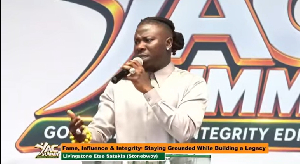 Stonebwoy at the 2026 Youth Against Corruption (YAC) Summit