When the Bank of Ghana unveiled its new Heritage Series banknotes, each denomination told a story about the country’s history, identity and achievements.
Two of the denominations, the GH¢20 and GH¢50 notes, celebrate creativity and national pride, featuring two personalities whose contributions continue to shape how Ghanaians see themselves.
GH¢20 – The Arts and Entertainment Note with Ephraim Amu
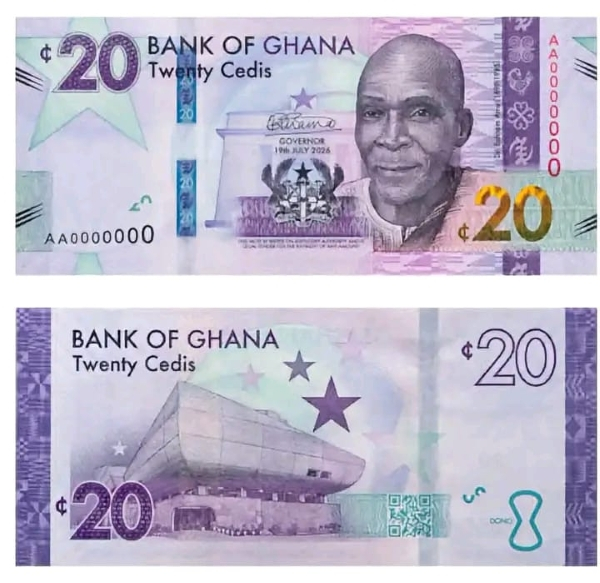
According to the presentation, the GH¢20 note celebrates the arts and entertainment sector.
The front of the note captures Dr Ephraim Amu, the renowned composer and musician widely regarded as one of the figures who helped shape Ghana’s cultural identity.
Amu was born in Avetile-Peki in the Volta Region on September 13, 1899. He attended primary school in Avetile before proceeding to Blengo for his secondary education.
Long before he became known for his achievements, Amu was recognised as a non-conformist.
According to a website dedicated to his life and work, he was dismissed from the Presbyterian Training College in Akropong in 1933 for wearing traditional kente cloth instead of a Western suit while preaching from the pulpit.
It is a striking irony that the cloth that reportedly led to his dismissal is now worn as stoles by clergy across Christian denominations in Ghana and beyond.
Amu also composed ‘Yɛn Ara Asase Ni’ (‘This Is Our Own Land’), a patriotic song that inspires national pride. It is performed at state and school ceremonies and serves as the sign-off tune for several national events.
As a composer, Amu blended Western choral harmony with indigenous African rhythms, drum language and tonal structures, including Akan and Ewe speech melodies. His works include ‘Adawura bɔ me’ (‘I Am the Bell’) and ‘Asɛm yi di ka’ (‘This Talk Has Got to Be Spoken’).
He also helped revive traditional Ghanaian instruments, most notably the atenteben, a bamboo flute, and the odurugya, incorporating them into formal music education and orchestral compositions. Both instruments remain in use today.
Amu taught and mentored students at institutions including Achimota School, the Kumasi College of Science and Technology, and the Institute of African Studies at the University of Ghana. Through his work, he influenced generations of African musicians, composers and thinkers. He died in 1995 in his hometown.
The National Theatre at the back
The back of the GH¢20 note features the National Theatre, representing Ghana’s creative arts and entertainment industry.
Built in 1992, the 1,490-seat auditorium and its multipurpose spaces host stage plays, concerts, dance recitals, film screenings, corporate meetings and community festivals.
GH¢50 – The Nationalism Note with Theodosia Salome Okoh
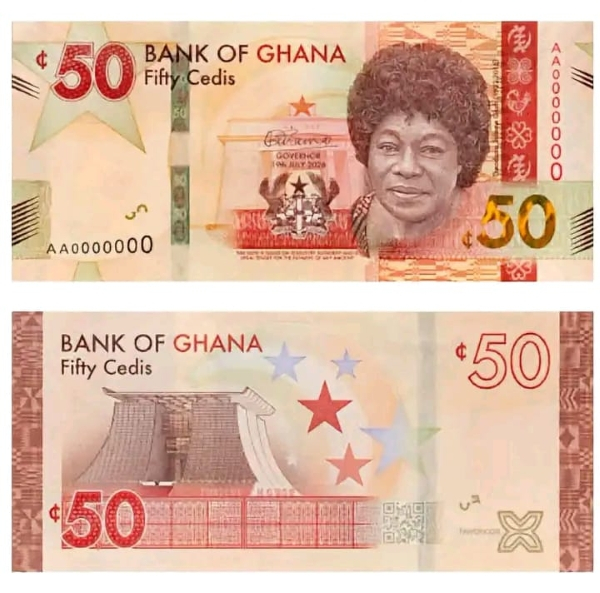
The GH¢50 note, on the other hand, focuses on nationalism. It captures Theodosia Salome Okoh, the woman credited with designing Ghana’s national flag.
When Ghana gained independence from Britain in 1957, the country needed a new national flag, and a call for designs was announced.
Okoh submitted a design that was adopted as the national flag when Ghana attained independence on March 6, 1957, under its first President, Kwame Nkrumah.
The flag also appears on the note as a symbol of national identity and patriotism.
While the other denominations represent different sectors and aspects of the country, the GH¢20 and GH¢50 notes honour two individuals whose contributions have helped shape Ghana’s cultural and national identity.
Their inclusion marks a recognition of their enduring legacies on one of the country’s most widely used forms of currency.
ID/EB
Entertainment of Thursday, 12 November 2026
Source: www.ghanaweb.com
Here are the arts and entertainment 'giants' captured on Ghana's new cedi notes
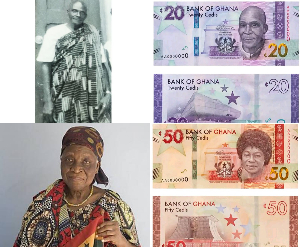 Dr Ephraim Amu, Mrs Theodosia Salome Okoh and the iconic National Theatre captured on the new notes