In Ghana, directions are often given using landmarks rather than street names.
Entire communities and bus stops become known by the institutions that define them: a school, a hospital, a church, a market, a company, or a hotel.
For decades, one such landmark stood proudly along Liberation Road in Accra.
“Shangri-La.”
Mention the name to generations of Accra residents, and they immediately know the location.
Long before GPS and digital maps became commonplace, the famous hotel had become so well known that the surrounding bus stop simply adopted its name.
Even after the hotel disappeared from the city’s skyline, the bus stop remained, preserving the memory of one of Accra’s most recognisable landmarks.
Behind that iconic name, however, lies a remarkable family story, one that stretches back nearly a century and is deeply woven into Ghana’s economic, commercial and infrastructural history.
The story is that of the Kassardjians. A family that arrived before Gold Coast became Ghana.
The Kassardjians are a Ghanaian-Lebanese family of Armenian descent whose roots in the country date back to the colonial Gold Coast.
Their story began with Aksor Kassardjian, regarded as the patriarch of the family.
He arrived on the Gold Coast in the 1930s and eventually settled in what is now Northern Ghana, particularly Tamale, where he established what was one of the country’s most influential construction businesses.
Through Kassardjian Construction Company Limited, Aksor became one of the leading road contractors of his generation.
His company supplied construction materials and undertook major public works projects, contributing to the development of roads, housing and infrastructure across the Gold Coast and later independent Ghana.
Much of the road infrastructure dating back to the 1950s bears the imprint of the family’s work.
His achievements helped establish the Kassardjian name as one synonymous with engineering, construction and nation-building.
Aksor’s younger brother, Baron Kassardjian, later joined him in Ghana and expanded the family’s commercial footprint.
Baron became one of the country’s foremost suppliers of heavy-duty construction equipment, serving as a principal distributor of JCB and Caterpillar machinery to the Government of Ghana during the nation’s formative years.
He also built a thriving agricultural export business, becoming one of the earliest major exporters of shea nuts from the Gold Coast to European markets.
Historical records indicate that during Queen Elizabeth II’s state visit to Ghana in 1961, the British monarch, accompanied by President Osagyefo Dr Kwame Nkrumah, paid a special visit to Baron Kassardjian at his offices in Tamale, an extraordinary honour that reflected the family’s standing in the country’s development during the early years of independence.
The family behind Shangri-La Hotel
While the Kassardjian family had already become renowned for construction and engineering, they later left another lasting mark on Accra through property development.
Among their most recognisable projects was Shangri-La Hotel, situated along Liberation Road in Accra’s Airport Residential enclave.
Built in 1988 as a 53-room hotel, Shangri-La quickly established itself as one of the city’s best-known hospitality destinations.
With its restaurants, swimming pool and conference facilities, it became a favourite meeting place for residents, business executives and travellers alike.
Like Korle Bu Teaching Hospital and the 37 Military Hospital, Shangri-La became a geographical reference point.
The surrounding bus stop adopted the hotel’s name, and even after the building was demolished years later, “Shangri-La” remained firmly embedded in Accra’s everyday vocabulary.
The hotel was developed by members of the Kassardjian family, including Armen Kassardjian, whose investments also extended to the Palm Royal Apartments, another ambitious real estate project that reflected the family’s long-standing interest in property development.
Today, different branches of the family continue to operate across diverse sectors of Ghana’s economy.
Among them is Hillburi Resort in Aburi, an upscale hospitality destination overlooking the Akuapem Ridge.
The resort, associated with Hratch Patrick Kassardjian and Kristina Heinel Kassardjian, has become one of the Eastern Region’s popular venues for tourism, conferences and weddings since opening in 2009.
The family has also maintained interests in elevator engineering, construction materials, petroleum supply, industrial equipment and agricultural commodities, continuing a business tradition that has spanned generations.
In 2019, Ghana’s Public Records and Archives Administration Department (PRAAD) organised an exhibition celebrating the works of the late Baron Kassardjian.
The exhibition showcased decades of photographs, awards and archival records documenting the family’s role in road construction, housing development and industrial growth across Ghana.
It served as recognition that the Kassardjians were not merely successful entrepreneurs but contributors to Ghana’s physical and economic transformation.
Nearly a century after Aksor Kassardjian first arrived on the Gold Coast, the family’s influence can still be found across Ghana. It exists in highways that connect towns and cities.
It survives in businesses that continue to operate. It overlooks the mountains from Hillburi Resort.
And in Accra, it lingers in everyday conversation. For many commuters, “Shangri-La” is simply the name of a bus stop.
But behind that familiar landmark lies the story of a family whose contributions helped shape modern Ghana, one road, one business and one landmark at a time.
PAT/EB
Entertainment of Wednesday, 4 November 2026
Source: www.ghanaweb.com
The story behind Accra’s famous 'Shangri-La hotel' and the family that built it
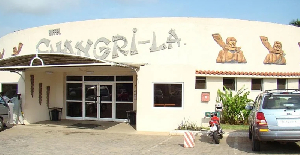 A file photo of the Shangrila-La hotel