Veteran Ghanaian filmmaker Socrate Safo has questioned the broadcasting practices of Bishop Daniel Obinim’s OBTV, alleging that the station has aired movies without the necessary copyright permissions.
In a Facebook post, Socrate Safo said he recently came across OBTV while scrolling through television channels and noticed that the station was airing a movie containing violent scenes in the middle of the day, allegedly without a visible classification warning.
He said the movie was followed by a counselling session featuring Bishop Obinim, who spoke about various problems he could help viewers address through prayers and healing.
However, the experience prompted Socrate Safo to question whether the necessary copyright rights had been secured for the movie being broadcast.
He claimed he contacted the Copyright Office to establish whether the movie had been properly licensed for broadcast and whether OBTV had the appropriate licensing arrangement for audiovisual content through the relevant collective management system.
According to him, the checks raised concerns about the station’s practices, while suggesting that OBTV is not the only television station facing such questions.
Socrate Safo argued that owning a television station does not give an individual or organisation ownership of the movies and programmes aired on the platform.
He noted that audiovisual works are protected under Ghana’s Copyright Act, 2005 (Act 690), meaning television stations are required to obtain the necessary permission or licences before broadcasting copyrighted content.
Media contributed to decline of Ghana's movie industry – Socrate Safo
“How come the Holy Spirit, or whatever spiritual power he believes in, has not whispered anything to him about copyright? Prayer does not replace a copyright licence. Anointing oil does not constitute permission from a filmmaker.
“Anointing oil does not constitute permission from a filmmaker. A church building does not become a copyright-free zone. And calling your television station a Christian platform does not give you a spiritual exemption from Ghana’s Copyright Act,” he stated.
He further criticised what he described as an inconsistency among some religious leaders who preach honesty, integrity and righteousness while allegedly failing to apply the same principles to the use of creative works.
Socrate Safo also pointed to the work of the Copyright Monitoring Team, which was established to monitor copyright works, investigate infringement and undertake anti-piracy activities to protect creators.
He questioned what would happen when copyright enforcement reaches religious television stations, sarcastically asking whether pastors would claim that the Holy Spirit failed to warn them.
“Perhaps we should start asking the Holy Spirit to expand His portfolio. He warns people about their enemies, He reveals people’s problems, He exposes witches and demons, He identifies sicknesses, He supposedly tells people who their future husbands and wives will be. But somehow, when a copyrighted movie is about to be broadcast without the necessary rights, He becomes mysteriously silent,” he said.
Despite the sarcasm, Socrate Safo stressed that copyright infringement is a serious issue for Ghana’s creative industry, which he said is already struggling to survive.
He called on television stations, particularly those owned by religious organisations, to obtain proper licences, pay for the content they broadcast and respect the rights of filmmakers and other copyright holders.
He also stressed that foreign films are not automatically free to broadcast, noting that Ghana’s copyright framework provides protection for qualifying foreign works under the country’s international obligations.
Socrate Safo concluded that his criticism was not an attack on Christianity but a call for consistency between religious teachings and practice.
“The creative industry does not need miracles from pastors. It needs respect for the law,” he stated.
AK/EB
Entertainment of Monday, 17 August 2026
Source: www.ghanaweb.com
Socrate Safo jabs Bishop Obinim over copyright issues
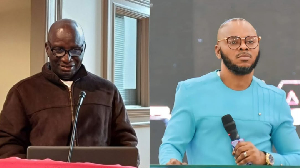 Socrate Safo questions OBTV’s alleged use of copyrighted movies without proper licensing