In Ghana, especially Accra, traffic is not just movement; it’s storytelling on wheels.
Look closely at any trotro (bus) or taxi, and you’ll realise you’re not just commuting; you’re reading a rolling diary, a sermon, a warning, a joke, sometimes even a clapback.
These inscriptions, boldly painted across windscreens, are more than decoration.
They are moving billboards of belief, struggle, and humour.
Let’s take a ride through some of the most iconic, hilarious, and thought-provoking phrases you’ll find on Ghanaian commercial vehicles.
Hustle and survival
If you’ve ever heard “Nkran yentena fie” (you don’t stay at home in Accra), you already understand the city’s unofficial motto: move or be left behind.
Other hustle-coded inscriptions include: “Lazy man no food”, “Suffer and gain”, “Hard work pays”, “No pain, No gain”.
These are not just words; they are daily reminders of the grind in a city where the trotro itself is a symbol of survival. The message is clear: no excuses.
The Untold Story of B-Bryte: The producer behind ‘Swagger,’ ‘Kill Me Shy,’ other hits
God and faith
If Ghana had an official vehicle language, it would be faith.
From subtle gratitude to full-on evangelism, many drivers hand their steering wheels over to God: “Nyame Adom” (By God’s grace), “The Lord is my Shepherd”, “Only God”, “Repent”, “Judgement Day”.
Some go deeper: “Heaven or Hell?”—a question and a warning in one; “God is still a cheerful giver”.
On Ghana’s roads, faith is not optional—it is fuel.
Messages about love, heartbreak, and relationship drama
Drivers don’t hold back when it comes to matters of the heart: “Fear woman”, “Love your neighbour as yourself”, “Trust no one”, “Because of a woman” (Ɔbaa nti).
And then the blunt ones: “Cry your own cry”, “You lie bad”.
These are not just phrases; they are unfinished stories painted in bold letters.
Jabs, warnings, and street wisdom
Some inscriptions feel like they were written for someone specific. In Ghana, every shade knows who it’s aimed at, and best believe that person knows themselves.
Examples include: “Enemies are not God” (Atamfo nye Nyame), “Trust no man”, “Consider your ways”, “Clean your mouth”, “Jealousy”.
Indirect communication is an art in Ghanaian culture. These slogans are essentially public messages delivered without naming names.
Messages on humour and chaos
Then there are the ones that catch passengers off guard: “4 + 4 = 11?”, confusion sponsored by vibes.
“No speed limit”, “Truck of the year ’90”, confidence unmatched. Random names and shoutouts, sometimes even calling out individuals.
Sometimes, the message doesn’t even need to make sense; it just needs to stand out.
Inscriptions on self-belief
Now and then, a driver makes a bold statement: “All eyes on me”, “Cool and Collected”, “Cash Man”, “I shall return”.
Because navigating Accra traffic daily requires a certain level of confidence.
Beyond the humour and drama lies a deeper layer, a kind of street philosophy.
These inscriptions often reflect life’s uncertainties, personal struggles, and existential thoughts: “Such is life”, “The world is nothing", “Yours is coming”.
In traffic, between honks and heat, these words resonate differently.
The trotro is already one of Ghana’s most important modes of transport, carrying thousands of urban commuters daily. Beyond that, it also serves as a preacher, a therapist, a comedian, and sometimes a warning sign.
So next time you’re stuck in traffic, look beyond your phone and read the car in front of you.
Because somewhere between “Ko awarepa” (marry well), “Nkran yentena fie”, and “Fear woman”, you might just find motivation, a life lesson, or the exact advice you didn’t know you needed.
PAT/EB
Entertainment of Friday, 27 March 2026
Source: www.ghanaweb.com
'Don't Rush', 'Marry Well', 'Fear Women': Witty inscriptions on Ghanaian 'trotros'
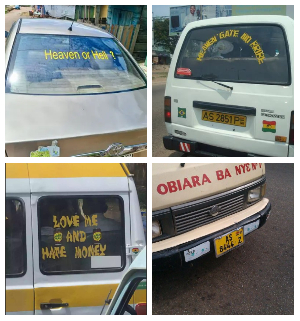 Some catchy phrases on Ghanaian commercial vehicles