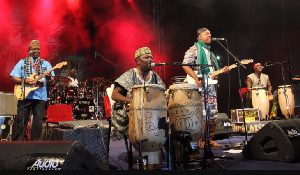
Ghana’s Highlife music, widely regarded as one of Africa’s most influential musical exports, is marking its 100th anniversary in 2025/2026.
However, ethnomusicologist John Collins has explained that the music itself existed long before the name “Highlife” was first used.
Speaking on Joy FM’s Showbiz Roundtable on March 14, 2026, Professor John Collins clarified that the centenary celebration is tied not to the birth of the music style but to the first time the word “Highlife” appeared in print.
According to the ethnomusicologist, music styles that later evolved into Highlife were already being performed before 1925, including forms such as Adaha and Sibi Saba.
Professor Collins noted that the term first appeared in a brochure produced by the Cape Coast Literary Association for a band in September 1925.
Highlife: The rhythm that defines Ghanaian life
That publication in 1925 is considered the earliest recorded use of the word “Highlife,” which is why the genre is now being celebrated for reaching a 100-year milestone.
“There was Adaha, and there was also a music called Sibi Saba, which existed before the term Highlife came into use. But the word Highlife itself was invented in September 1925. It appeared in a brochure by the Cape Coast Literary Association for a band in Ghana. That was the first time the word Highlife appeared in print,” he explained.
He further indicated that although the term originated in the Gold Coast, its usage in neighbouring countries such as Nigeria came in 1938.
“If you go to Nigeria, you will not find the word Highlife in print until 1938, which was later. So it came after Ghana,” he shared.
Professor Collins also disclosed that Ghana’s first President, Dr Kwame Nkrumah, once attempted to replace the colonial-era name “Highlife” with the indigenous term Sibi Saba, which he believed better reflected the music’s African roots.
“Kwame Nkrumah later attempted to replace the name Highlife and return to the term Sibi Saba. Highlife was an English word from the colonial period, and he believed it might be better to return to a Fante word. But by then, the name Highlife had already spread widely, and everyone knew the music by that name, so it was too late to change it,” he added.
Historically, Highlife traces its origins to the 19th century in coastal towns of the Gold Coast, particularly in cities such as Accra, Cape Coast and Sekondi-Takoradi.
These port cities served as centres of trade and cultural exchange where Africans, Europeans and Caribbean sailors interacted.
The genre gradually developed from the blending of several musical traditions, including indigenous Akan and Ga rhythms, European brass band and military marching music, as well as Western ballroom and jazz influences.
By the 1930s and 1940s, Highlife had begun evolving from music associated mainly with the elite into a popular urban sound that resonated across West Africa, eventually becoming one of the continent’s most celebrated musical genres.
AK/EB