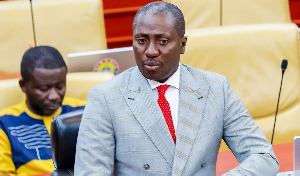
Minority Leader in Parliament, Alexander Afenyo-Markin, has criticised the governing National Democratic Congress (NDC), accusing the party of benefiting from harsh political rhetoric while in opposition but now treating similar conduct by its opponents as a criminal offence.
Speaking at the National Emerging Leaders Economic Forum (NELEF) 2026 at the University of Professional Studies, Accra (UPSA) Auditorium, Afenyo-Markin said he does not support or defend the use of insults and personal attacks in political discourse.
He argued that political discussions should instead be centred on substantive issues, policy alternatives and mutual respect, while maintaining that the right to freedom of expression must be protected.
“I do not, nor will I ever, defend the politics of insults and personal abuse. I believe public discourse must be anchored on intellectual rigour, mutual respect and policy alternatives,” he said.
However, the Minority Leader accused the current NDC administration of applying a different standard to political commentary, particularly when similar rhetoric is directed at the government.
'Democracy and free speech under siege in Ghana' - Dr Bawumia
He argued that the NDC, while in opposition, benefited politically from a style of political communication that included strong and sometimes harsh rhetoric, which he said contributed to the party's return to power.
“However, if there’s any government in Ghana’s Fourth Republic that has benefited from the politics of insult, it is this current NDC government. They built the entire platform on it. It helped carry them back into office, and now, having ridden that wave to power, the very same conduct aimed the other way is being treated as a crime,” he noted.
Afenyo-Markin further raised concerns about the use of legal provisions to deal with political speech and commentary, arguing that certain sections of the Electronic Communications Act, 2008 (Act 775), and the Criminal Offences Act, 1960 (Act 29), should not be used to suppress legitimate political expression.
According to him, the application of these provisions against political opponents and individuals who make critical comments could have implications for Ghana's constitutional protections and democratic freedoms.
“The deliberate weaponisation of Section 76 of the Electronic Communications Act, 775 of 2008, and Sections 207 and 208 of the Criminal Offences Act, 29, to silence political opponents or criminalise political commentary is an affront to the constitutional guarantee of freedom of speech and expression and to the democratic principles upon which our republic is founded,” he added.
The Minority Leader also expressed concern about what he described as a worrying trend of arrests involving individuals over comments or content shared publicly.
He cited the reported arrest of Techiman senior nursing officer Salomey Bafoh Awiti, as well as social media personality Fante Comedy, as examples of cases that, in his view, raise questions about the limits of state intervention in matters involving public commentary.
@dadzietv LIVE UPDATE | Minority Leader Alexander Kwamena Afenyo-Markin said he does not defend the politics of insult or personal abuse, but accused the NDC government of benefiting from such political discourse before returning to power. “I do not, I repeat, I do not, nor will I ever defend the politics of insult and personal abuse. I believe public discourse must be anchored on intellectual rigour, mutual respect and policy alternatives.” He, however, argued that the current government had previously benefited from what he described as the “politics of insult,” and questioned why similar conduct directed at those in government was now being treated as a crime. Afenyo-Markin made the remarks at the National Emerging Leaders Economic Forum (NELEF) 2026 at the UPSA Auditorium in Accra.
♬ original sound - Dadzie TV
Foundries, Machines and Jet Engines: Ghana’s untapped engineering potential
AK/AM