Private legal practitioner, Kwame Boafo Akufo, has challenged the financial rationale behind the collapse of uniBank, describing the figures presented by authorities as inaccurate, unaudited, and legally problematic.
His remarks follow the Attorney-General’s decision on July 22 to file a nolle prosequi in the criminal case involving former finance minister, Dr Kwabena Duffuor and seven others.
The accused had faced charges related to the 2018 collapse of uniBank, including theft and money laundering. The case, The Republic v. Kwabena Duffuor & 7 Others (CR/0248/2020), was part of Ghana’s high-profile financial sector clean-up exercise.
However, the Attorney-General’s office, through Deputy Attorney-General, Dr Justice Srem-Sai, announced the discontinuation of the case due to what it described as “significant recoveries” of state funds—reportedly reaching a 60% threshold.
In an interview on Morning Starr with Naa Dedei Tettey on Thursday, July 31, Akufo questioned the integrity of the figures used to justify uniBank’s license revocation, particularly the alleged GH¢ 5.3 billion liability attributed to shareholders and related parties.
“That figure was never validated,” Akufo stated. “From the outset, the receiver was clear that the figure of GH¢5.7 billion was not a validated figure. It had not been audited in accordance with international standards, so that figure is not a statement of fact — it was a notion that was put out there.”
He argued that, over time, the alleged liability was significantly reduced through court proceedings and reconciliation exercises - from GH¢5.7 billion to GH¢2.8 billion, and further down to GH¢2 2 billion.
Of that revised amount, he explained, GH¢824 million was tied to properties held in trust for the bank, while GH¢1.2 billion was owed by third-party debtors. He also noted that the government itself owed uniBank GH¢2.9 billion through Treasury bills, unpaid interest, and ESLA bond arrears.
“At the heart of this dispute is a miscalculation and misdistribution of liability, which was based on inaccurate figures,” he asserted.
Meanwhile, the Minority in Parliament has criticized the Attorney-General’s decision to withdraw the charges, demanding a comprehensive explanation and warning of possible legal action.
They argue that the discontinuation undermines accountability for the financial crisis that led to the collapse of several indigenous banks and cost taxpayers billions of cedis.
Business News of Saturday, 2 August 2025
Source: starrfm.com.gh
uniBank was collapsed on inaccurate, unaudited figures – Boafo Akufo
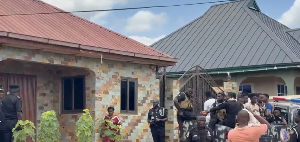
 A photo of the defunct uniBank building