Energy and Green Transition Minister, Dr John Abdulai Jinapor, has assured Parliament that the government will retain full ownership of the Electricity Company of Ghana (ECG) despite plans to introduce private sector participation in its operations.
He gave the assurance when he addressed Parliament on Friday, November 27, 2026, explaining that the proposed arrangement would not involve handing over the entire power distribution company to a single private contractor.
Keda Ghana pays GH¢248.3 million in taxes, urges businesses to compete fairly
Instead, the government intends to introduce multiple private concessionaires to manage designated areas of ECG's distribution operations under a competitive tendering process.
Dr Jinapor explained that ECG would remain the parent company responsible for selling electricity in bulk to the concessionaires, who would be required to collect payments from consumers and account for the revenue.
“That is to say, we are not handing the whole of ECG to one company. ECG will still be a company that exists. What it will do is that it will be a parent company that sells wholesale power to these multiple concessionaires and they would have to account for the money,” he said.
He stressed that the government is considering a competitive tender process to select the private operators, rather than relying on a single-source contract.
“So let me assure the Minority Leader that we are not going for a single sole sourcing contractor but to be true competitive tender with multiple concessions so we can benchmark and monitor what concessionaire A, B, C, D are doing in order to ensure effective delivery of services,” he stated.
Dr Jinapor said ECG would establish performance standards for each concessionaire and retain the right to take back control of any concessionaire that fails to meet the agreed requirements.
He disclosed that the companies would be required to provide a three-month standby letter of credit as part of the conditions for securing a concession.
“If they do not meet that requirement, we take that money from the bank and by the third month, if they are unable to meet, ECG has a right to terminate the concession and assume ownership back,” he explained.
The Energy Minister further clarified that the private companies would not own the electricity distribution assets, adding that ECG would continue to monitor and maintain control over its infrastructure.
Using a vehicle ownership analogy, he explained that the arrangement would allow a private operator to use ECG's assets to provide services and collect revenue while the company retains ownership.
“The car still belongs to me. Every day when you go and come, I give you a quota, you pay the money to me,” he said.
Dr Jinapor also emphasised the need for local companies to participate in the proposed arrangement, saying the government wanted Ghanaian businesses to play a major role in the electricity distribution sector.
He said foreign companies could partner with local firms through joint ventures where the Ghanaian companies lacked the technical or financial capacity to operate independently.
“But I want to insist that a certain percentage, a certain minimum threshold be reserved for Ghanaian companies. Where we can, would ensure that we have 100% takeover by Ghanaian companies,” he added.
He said the government was committed to ensuring transparency and value for money throughout the process.
The Minister further disclosed that the proposed framework would be brought before Parliament for scrutiny and approval after consultations with relevant stakeholders.
ANAS/EB
“We Like the Design, Release It Now” – Ghanaians React to New Currency Notes
Business News of Saturday, 28 November 2026
Source: www.ghanaweb.com
Government to retain full ownership of ECG under private sector plan – Dr Jinapor
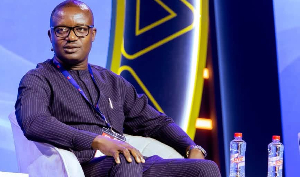 Dr John Abdulai Jinapor is the Energy and Green Transition Minister