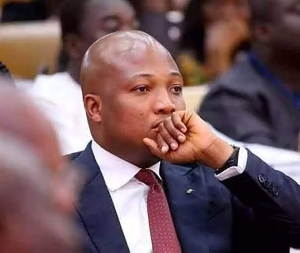
The Governor of the Bank of Ghana (BoG), Dr Johnson Pandit Asiama, says he still wants to see lending rates fall below 10 per cent, but has made clear that the goal is a personal aspiration rather than an official commitment of the central bank.
Speaking at the press briefing after the 133rd Monetary Policy Committee (MPC) meeting last Wednesday, Dr Asiama was asked about his single-digit target and the structural barriers to passing on lower rates to borrowers.
“This was an aspirational kind of thing. My personal belief is that this country will be so much supported if lending rates could be below single digits,” he said. “That’s a personal aspiration. It’s not an official commitment.”
The remarks represent a softer tone on a goal the Governor has repeatedly championed since taking office. In June 2025, addressing the Association of Ghana Industries (AGI), he set out an ambitious target. “My vision is to see lending rates fall to less than 10 percent before the end of my four-year term,” he said. At the time, average lending rates stood at about 27.4 per cent.
In December 2025, he pledged to keep pushing, saying “My determination is to see interest rates come down to single digits in the days ahead,” and at the Kwahu Business Forum in April this year, he described it as his daily prayer.
On Wednesday last week, the Governor said market rates were already approaching that level for the best borrowers. “Currently, the GRR is close to that. The GRR, I’m told, is about 10.01 per cent,” he said, referring to the Ghana Reference Rate, the benchmark banks use to price loans. “What it means is, if you are a good customer at the banks, you can borrow at lending rates of as low as around 10 per cent.”
“But on average, most lending rates hover around between 15 and 16 per cent. So rates are going down. And we hope that going forward, we’ll see lower rates, lower lending rates,” he added.
He stressed that the central bank was not forcing rates down. “That is determined by the system. It is not we pushing that for sure,” he said.
BoG data show how far rates have fallen. The average lending rate dropped to 15.8 per cent in October 2026, from 22.2 per cent a year earlier, while the 91-day Treasury bill rate fell to 4.6 per cent and the interbank rate to 10.2 per cent.
The gap between the benchmark rate and what most borrowers actually pay comes largely from the risk premium banks charge for possible default. Banks have long argued that a single low rate for all customers is not possible. At an engagement with the Ghana National Chamber of Commerce and Industry in February, a banking industry representative said that, depending on a customer’s credit profile, one borrower might get a loan at 17 per cent while another is charged 20 or 23 per cent.
That is where the BoG’s other reforms come in. A high stock of bad loans pushes up the premium banks charge, and the BoG is pressing all regulated institutions to cut their non-performing loans ratio to 10 per cent by December. The industry ratio stood at 13.1 per cent in October. Lower bad loans, the Governor said, make credit expansion “beneficial in all ways”.
The MPC’s decision on Wednesday last week to move the policy rate from 14 per cent to 11 per cent and narrow the policy corridor is also meant to sharpen the link between central bank signals and market rates. The Governor said the changes would “support the transmission of our policy signals”.
Lower rates are already feeding into credit. Private sector credit grew by 37.2 per cent year-on-year in October, and by 30 per cent in real terms, as businesses and households took advantage of cheaper loans.
Business News of Friday, 27 November 2026
Source: economytimesnews.com
BoG Governor roots for single-digit lending rates
 Johnson Asiama is the Governor of the Bank of Ghana