The Ghana Cocoa Board (COCOBOD) and its wholly owned financing subsidiary, Cocoa Capital PLC, are working to overcome a financing shortfall arising from the first tranche of their new domestic commercial paper programme, while reviewing the timing and structure of subsequent fundraising to ensure that cocoa purchases are not disrupted.
The immediate challenge follows Cocoa Capital’s inaugural commercial paper issuance, which raised GH¢3.39 billion against an indicative target of GH¢4 billion, leaving a funding gap of approximately GH¢610 million, or 15.25 per cent of the amount originally envisaged.
The 266-day securities, issued on October 5, 2026, attracted total investor demand of GH¢3.59 billion, of which GH¢3.39 billion was accepted at a uniform annual interest rate of 11 per cent. The shortfall has complicated the financing timetable for the 2026/27 crop season, particularly because the first tranche was intended to provide working capital for the initial phase of cocoa purchases.
The wider Domestic Cocoa Notes Programme envisages raising GH¢16.3 billion, comprising GH¢14 billion in commercial paper to finance seasonal cocoa purchases and GH¢2.3 billion in medium- to long-term bonds to refinance COCOBOD’s legacy obligations.
One important mechanism being used to manage the immediate financing pressure is the recycling of funds generated from cocoa exports, rather than committing the entire season’s expected production to financing arrangements at the beginning of the purchasing cycle.
COCOBOD Chief Executive, Dr Ransford Abbey, has explained that the board intends to limit the proportion of the crop used as collateral for financing to no more than 60 per cent. The intention is to raise only part of the required financing at a time, use the proceeds to purchase cocoa, and then recycle the resulting export revenues to support further purchases.
“If you decide that you are going to go for half the money and turn it around twice within that nine-month period, then you will not need to collateralize more than 55 or 60 per cent,” Dr Abbey has explained.
This approach is particularly important because the new financing model relies on receivables from selected executed cocoa forward-sales contracts assigned to Cocoa Capital PLC. Export proceeds are channeled through designated collection and escrow accounts, with debt-service obligations prioritized under an agreed payment waterfall.
The arrangement is intended to ensure that cocoa purchases can continue without COCOBOD having to raise the entire GH¢14 billion seasonal requirement upfront or pledge an excessively large proportion of its expected crop. The programme also requires receivables coverage of at least 1.2 times the applicable debt-service obligations.
However, recycling does not eliminate the financing gap. It provides a mechanism for managing the timing of cash requirements, particularly when export receipts become available, but the initial liquidity needed to pay Licensed Buying Companies (LBCs) remains critical.
That challenge is compounded by outstanding payments to cocoa buyers. The Chamber of Cocoa Marketers Ghana had previously estimated that COCOBOD owed LBCs approximately GH¢4 billion from the preceding crop season.
The Chamber’s Chief Executive Officer, Victus Dzah, warned that the arrears were undermining the ability of indigenous cocoa buyers to resume purchasing.
“Cocobod has not paid us. How are we going to go back to the field to buy cocoa?” he asked.
He also disclosed that some buying companies were borrowing at interest rates of up to 40 per cent while awaiting settlement of their outstanding claims.
The implications are significant because the new season’s producer price has been increased to GH¢42,400 per tonne, equivalent to GH¢2,650 per 64-kilogramme bag. Financing must therefore be sufficient not only to meet COCOBOD’s purchasing commitments but also to ensure that LBCs have the working capital necessary to pay farmers promptly.
Reconfiguring subsequent commercial paper tranches
The original commercial paper fundraising schedule envisaged three tranches: GH¢4 billion in the first issuance, another GH¢4 billion in the second, and GH¢6 billion in the third.
Consequently, the GH¢610 million shortfall from the inaugural issuance has to be accommodated within the remaining GH¢10 billion fundraising programme if the overall GH¢14 billion seasonal target is to be maintained.
Discussions within Cocoa Capital PLC and COCOBOD itself have considered three options.
One possible adjustment is to increase the second tranche beyond its original GH¢4 billion indicative allocation, incorporating some or all of the first tranche’s shortfall. The third tranche could then be adjusted correspondingly, depending on the volume of cocoa purchased, the availability of export receipts and the remaining seasonal financing requirement.
Another option is to change the maturity structure of subsequent commercial paper issuances. Shorter-dated securities, potentially with 90-day or 180-day maturities, could appeal to institutional investors reluctant to commit funds for the original 266-day period.
A further possibility is supplementary short-term borrowing from domestic commercial banks, using assigned cocoa export receivables as security, to provide temporary liquidity until the next commercial paper issuance.
There is also a pricing consideration. The first issuance cleared at 11 per cent, at the upper end of its original indicative interest-rate guidance of 10.5 to 11 per cent. If investors require higher returns to participate in subsequent offerings, Cocoa Capital may have to accept increased financing costs or improve the security and maturity structure of the instruments.
Instructively. even before the inaugural issuance, the Deputy Chief Executive of COCOBOD responsible for Finance and Administration, Ato Boateng, had indicated that the board intended to return to the market relatively quickly.
Business News of Thursday, 26 November 2026
Source: economytimesnews.com
COCOBOD seeks to close GH¢610 million funding gap
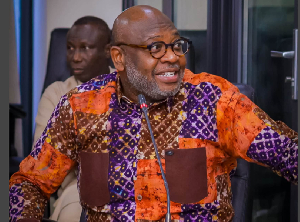 Dr Ransford Abbey is the CEO of COCOOBOB