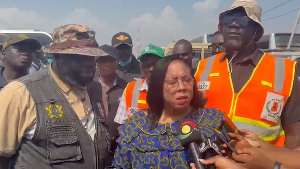
Member of Parliament for Awutu Senya East, Phillis Naa Koryoo Okunor, has highlighted the government's renewable energy and nuclear power initiatives in the 2027 Budget Statement, describing them as critical steps towards achieving long-term energy security and independence for Ghana.
Contributing to the parliamentary debate on the budget, the National Democratic Congress (NDC) legislator drew attention to provisions under Section 5 aimed at making solar energy equipment more affordable through import duty reductions and Value Added Tax (VAT) exemptions on solar panels and batteries.
According to her, the measures are intended to expand access to renewable energy and enable ordinary Ghanaians, particularly small business operators and essential service providers, to benefit from more affordable electricity alternatives.
"We are putting the power of the sun in the hands of ordinary Ghanaians," she stated.
She explained that the initiative would benefit market traders who require reliable electricity to operate their businesses, healthcare facilities that depend on uninterrupted power to preserve essential medicines, and drivers transitioning to electric vehicles.
The MP said expanding access to solar energy would empower individuals and businesses to generate and utilise electricity more independently, while supporting the country's broader renewable energy ambitions.
Beyond the immediate measures to promote solar energy, she highlighted the government's long-term nuclear power ambitions, referencing Sections 3 and paragraphs 374 to 387 of the 2027 Budget.
She drew parallels between the proposed nuclear energy programme and the vision of Ghana's first President, Dr. Kwame Nkrumah, whose leadership led to the construction of the Akosombo Dam approximately six decades ago.
According to her, the government is committing $200 million to a 24-month nuclear readiness programme, with the objective of signing the Engineering, Procurement, Construction and Financing (EPCF) contract by 2028.
She described the proposed investment as an important step towards diversifying Ghana's energy generation sources and securing a reliable electricity supply for future generations.
Naa Koryoo maintained that combining renewable energy investments with preparations for nuclear power generation would strengthen the country's capacity to meet growing electricity demand and reduce its vulnerability to energy supply challenges.
Concluding her contribution, she said the government's overarching objective was to establish a sustainable energy system capable of guaranteeing uninterrupted electricity supply.
"As I conclude, all what we want to do is to keep the lights on for good," she told Parliament.
Emphasising the importance of energy independence, she added: "We are delivering permanent energy sovereignty. Yes, we are keeping the lights on for good. Speaker, we are not running the nation on a rented generator."
Business News of Wednesday, 25 November 2026
Source: www.ghanaweb.com
Phillis Naa Koryoo Okunor highlights solar tax exemptions, nuclear energy plans in 2027 Budget
 Phillis Naa Koryoo Okunor is the member of parliament for Awutu Senya East