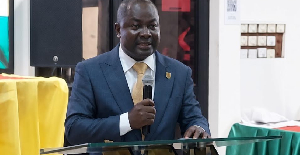
The Governor of the Bank of Ghana (BoG), Dr Johnson Pandit Asiama, has warned that falling global gold prices pose a risk to Ghana’s economy, because the country still relies on the metal for more than 60 per cent of its export earnings. Calculations based on BoG data show the slump could cost the country nearly US$300 million a month in foreign exchange.
Speaking at the press briefing after the 133rd Monetary Policy Committee (MPC) meeting in Accra last Wednesday, Dr Asiama said the sharp drop in prices had exposed how vulnerable the economy remains to swings in commodity markets.
“It is true that gold prices are falling, whereas gold still constitutes over 60 per cent of our exports. So it is an issue. The country is still exposed to commodity price shocks,” he said. “So it is something all of us have to work on, and the answer is greater diversification of our exports.”
Gold has fallen steeply from its peak earlier this year. The price fell about 31.5% from the record $5,594.82 set in January by November 16, according to Reuters data. On the day of the MPC announcement, spot gold fell 2% to $3,770.12 an ounce on Wednesday morning, November 18. Earlier in the session it touched $3,757, its lowest level since September 2025.
The decline comes at a sensitive time for Ghana’s external accounts. According to the MPC, gold made up about 67 per cent of total export earnings between January and October 2026, the main driver of a US$13.0 billion trade surplus. Even so, gross international reserves fell to US$12.1 billion, about 4.4 months of import cover, by November 17, from US$13.8 billion, or 5.7 months, at the end of December 2025.
The impact on the country’s dollar earnings is significant. Gold exports have averaged roughly US$2 billion a month this year, so every fall in price cuts directly into foreign exchange receipts. The average price in August was US$4,408 an ounce. At Wednesday’s level of about US$3,770, the same quantity of gold earns roughly 14.5 per cent less. Calculations by the Economy Times newspaper showsthat, if export volumes hold steady, Ghana could receive nearly US$300 million less every month, or close to US$600 million over November and December alone.
The slump has also eroded the value of the gold already held in the central bank’s reserves. Official gold reserves increased from 24.4 tonnes valued at US$3.652 billion in June 2026 to 25.2 tonnes in August, although the recorded value stood at US$3.565 billion, according to the BoG’s latest published holdings data. At current prices, the same 25.2 tonnes would be worth about US$3.05 billion, more than US$500 million less. Every US$100 drop in the price of an ounce takes about US$81 million off the value of those holdings.
The strain is already visible in the BoG’s latest data. According to the Bank’s Summary of Economic and Financial Charts, released on November 17, Ghana’s monthly trade surplus shrank to just US$89.7 million in October, as exports fell to US$2.07 billion against imports of US$1.99 billion. Gross international reserves stood at US$11.90 billion at the end of October, with net international reserves at US$9.54 billion, before edging up to US$12.1 billion by November 17.
At the same time, the import bill is rising. The BoG data show Brent crude prices up 75.8 per cent so far this year, increasing what the country spends on fuel imports. The cedi has also come under pressure, depreciating 10.6 per cent against the US dollar since January to trade at GH¢11.69 as at November 13.
The Governor listed gold prices among the factors the Bank is watching closely. “Gold price is a big part of it, and so to the extent that gold prices are going down, that is a factor that needs to be watched,” he said. He added that the Bank’s outlook is for prices to strengthen over the medium term.
The risk is greater now that the Governor says the BoG has stepped back from selling dollars to the market, a role now handled by the Ghana Gold Board (GoldBod). “Currently we are not involved in the intermediation function. That has been yielded to the Gold Board for now,” he said. Lower gold prices therefore cut both the dollars GoldBod can supply to importers and the reserves the central bank can build, just as festive-season demand for dollars rises.
Dr Asiama said the long-term answer lies in broadening the export base and adding value to raw commodities before they leave the country. “We need to focus more on some of our non-traditional exports. We need to do greater processing of even the major commodities that we export currently: oil, gold, cocoa,” he said. “If we can process more of those commodities, that will help us when it comes to resilience in the face of falling commodity prices.”
He said the 2027 Budget, presented by the Minister of Finance, DrCassiel Ato Forson, contained measures in that direction.
Asked whether the MPC’s move of the policy rate from 14 per cent to 11 per cent was a risk at a time of falling gold prices, the Governor repeated that the decision was not a cut. “We haven’t reduced the policy rate. All we have done is to realign it,” he said. “All we have done is to enhance the transmission of signals of our monetary policy.”
The gold price decline adds to other pressures on the external sector. The BoG data show cocoa prices down 4.4 per cent this year, with output expected to fall as El Niño threatens yields across West Africa, while the Bank has warned of higher external payment obligations.
Business News of Wednesday, 25 November 2026
Source: economytimesnews.com
Falling gold prices threaten Ghana's economy – BoG Governor
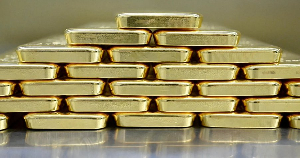 File photo of gold bars