The 2027 Budget Statement puts the remaining liabilities on the Ghana Cocoa Board’s (COCOBOD) cocoa roads programme at GH¢6.9 billion. That is about GH¢2.55 billion more than the GH¢4.35 billion the Finance Ministry announced in February, after a review of the projects.
Presenting the budget to Parliament, Finance Minister Dr Cassiel AtoForson said “cocoa roads liabilities were rationalized from GH¢21 billion to GH¢6.9 billion following a joint field verification exercise”. He said government has transferred the ongoing cocoa roads projects to the Ministry of Roads and Highways.
Nine months earlier, the Ministry gave a different figure. In a press release on cocoa sector reforms dated February 12, 2026, the Ministry of Finance said a rationalization of COCOBOD’s road commitments had been completed under its supervision. “Upon the completion of the exercise, the total exposure of GH¢21.7 billion has been reduced to GH¢4.35 billion,” the release stated. It added that Cabinet had directed the transfer of the GH¢4.35 billion in cocoa roads liabilities to the Ministry of Roads and Highways.
The budget statement does not explain how the GH¢6.9 billion relates to the February figure. It does not say whether the higher amount reflects interest, newly verified claims, projects added after February or a different way of measuring the liabilities. The starting figures also differ, at GH¢21 billion in the budget against GH¢21.7 billion in the February release.
The GH¢6.9 billion matches a target set under Ghana’s 2023 programme with the International Monetary Fund. According to the February release, government agreed with the IMF in 2023 to rationalize COCOBOD’s road commitments of GH¢21.7 billion to GH¢6.9 billion. The release said “the previous board and management of COCOBOD failed to conduct this exercise”.
The difference matters because the bill now sits with the state. With the projects and liabilities transferred to the Roads Ministry, payment for the cocoa roads falls on the national budget. The 2027 Budget allocates GH¢11.3 billion to the Ministry of Roads and Highways, including GH¢7.8 billion for capital expenditure and GH¢3.5 billion for the Road Maintenance Trust Fund. It does not show how much of that is set aside for the cocoa roads projects.
The road programme has weighed heavily on COCOBOD. The February release states that COCOBOD awarded cocoa roads contracts of up to GH¢26.5 billion between 2014 and 2024. Of that, GH¢21.5 billion was awarded in the 2018/19, 2019/20 and 2020/21 crop years. The release identified road construction as a major source of the regulator’s financial difficulties.
The World Bank had also flagged the exposure. Its senior economist David Elmaleh put outstanding cocoa road contracts at GH¢21 billion, about US$1.3 billion, at the end of 2024. He was speaking at the Bank’s Ghana Public Finance Review in February 2025. The February release also referred to a US$500 million World Bank facility, announced in the 2026 Budget, to build agricultural roads, including in cocoa-growing areas.
In February, Cabinet directed the Attorney-General to commission a concurrent forensic audit and criminal investigation into COCOBOD’s activities over the previous eight years, the release said. The 2027 Budget gives no update on that audit.
On COCOBOD’s wider finances, the budget shows modest progress. Its debt stock fell from GH¢32.5 billion in March 2025 to GH¢30.55 billion as at August 2026, a reduction of about GH¢1.95 billion, or sixper cent. Debt stock and road liabilities are reported as separate measures in the budget.
The regulator is also changing how it funds cocoa purchases. For the 2026/27 crop season, the Minister said, government has “implemented a new financing model for cocoa purchases using a domestic liquidity framework supported by a Special Purpose Vehicle (Cocoa Capital PLC), cocoa bonds and commercial paper”.
The sector’s output is recovering. Cocoa production reached 771,000 metric tonnes in the 2025/26 crop year as at August 2026, with cumulative purchases of 690,000 metric tonnes, according to the budget.
Prices have fallen sharply. Cocoa averaged US$4,543.15 per tonne in the first nine months of 2026, down 48.9 per cent from a year earlier, before recovering to US$5,920 in September. Higher volumes still lifted cocoa export earnings by 15.9 per cent to US$3.0 billion in the first nine months.
The outlook carries a risk. The budget says gold and oil earnings are expected to help offset “the anticipated decline in cocoa production due to the effects of El Niño”.
Government’s longer-term plan is to keep more of the crop’s value at home. Under the New Economy programme, Ghana will process at least 50 per cent of its cocoa locally by 2028 and 100 per cent by 2030, “completing the transition towards a ban on raw cocoa exports”.
Business News of Monday, 23 November 2026
Source: economytimesnews.com
Cocoa roads bill rises to GH¢6.9bn in 2027 Budget
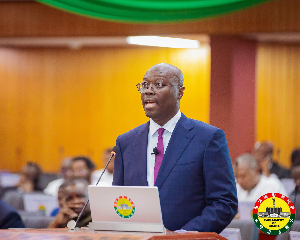 Dr Cassiel Ato Forson is the Minister of Finance