The 31st United Nations Climate Change Conference (COP31) has concluded without an agreement after disagreements over fossil fuels derailed negotiations among participating countries in Antalya, Türkiye.
The negotiations collapsed on Sunday, November 22, 2026, following more than two weeks of discussions, with the European Union (EU), the United Kingdom, Panama and the Marshall Islands rejecting the proposed final agreement.
The draft agreement made no reference to fossil fuels, which became a major point of contention among delegates, particularly those pushing for stronger commitments towards transitioning away from the energy source.
COP31 President Murat Kurum confirmed that countries had failed to reach a consensus on the proposed document, ruling out the possibility of preparing a new draft.
"It is clear that there are parties in this hall who oppose this text. We recognise that there is no consensus on this document. Therefore, these decisions have not been adopted," he said.
The proposed agreement would have formally acknowledged that global warming was on course to exceed the 1.5°C limit set under the Paris Agreement. It also included calls for the accelerated development of carbon-removal technologies to help reverse the trend.
However, negotiations reportedly faced strong opposition from Saudi Arabia and other oil-producing countries, which pushed to exclude explicit references to fossil fuels from the agreement.
Speaking on behalf of the EU, Irish minister Darragh O’Brien said the bloc could not support a climate deal that failed to address the future of fossil fuels.
He accused some oil-producing countries of hijacking the summit, arguing that the proposed agreement fell short of what was needed to address the climate emergency.
The EU representative said the bloc "will not accept a COP that greenwashes fossil fuels", insisting that the draft did not reflect the urgency of the global climate crisis.
The United Kingdom also expressed disappointment over the failure to reach an agreement, with its delegation arguing that the proposed text did not match the scale of the climate emergency.
UK delegation spokesperson Kate Hughes said the country had worked until the final moments of the negotiations to secure what she described as a balanced and credible outcome.
"But what is before us is not commensurate with the urgency of overshoot, the scale of the climate crisis or the impacts already being felt by the most vulnerable people and communities around the world," she said.
UK Energy Secretary Miatta Fahnbulleh on his part said the failure to secure an agreement would only strengthen the country's commitment to working with international partners to address climate change.
"This only strengthens our resolve to work with partners around the world on the genuine progress made in Antalya on tackling the climate crisis," she stated.
UN Secretary-General António Guterres also expressed disappointment over the outcome but maintained that the failure to reach a political agreement did not change the scientific evidence on climate change.
"But this setback does not change the facts. There may be no consensus in the negotiating room. There is no ambiguity in the science," he said.
Guterres further criticised the influence of powerful fossil fuel interests, accusing them of obstructing efforts to address climate change while benefiting financially from activities that contribute to the crisis.
He indicated that such interests were taking "a page from Big Tobacco’s playbook: distorting the science, delaying policy, blocking action and piling up huge profits while people everywhere pay the price".
Meanwhile, Russia supported the decision to exclude explicit references to fossil fuels from the proposed agreement.
Russian delegate Sergei Kononuchenko argued that calls for a rapid phase-out of fossil fuels should be considered against the practical realities of global energy production.
"From year to year we are urged to have a rapid phase out of fossil fuels. But let's turn not to slogans," he said.
He added that even the most ambitious scenarios for limiting global warming to 1.5°C required significant reductions in fossil fuel use, but not their complete disappearance.
China, another major player in global climate negotiations, expressed disappointment over the failure to reach a consensus but indicated that it had accepted the final version of the proposed document.
Chinese Vice-Minister of Environment Li Gao said Beijing was disappointed that countries had failed to agree on the overarching decision, adding that the negotiations had left out several issues important to developing countries.
COP31 negotiations president Chris Bowen also described the outcome as disappointing, identifying the transition away from fossil fuels as one of the major issues that prevented countries from reaching an agreement.
What the COP31 deadlock means for Ghana and Africa
The failure to reach a consensus raises concerns for Ghana and other African countries, which contribute relatively little to global greenhouse gas emissions but remain highly exposed to climate-related risks.
For Ghana, the implications include continued pressure on climate adaptation efforts, as flooding, changing rainfall patterns, coastal erosion and threats to agricultural productivity affect communities and livelihoods.
The absence of a stronger collective outcome also highlights the challenges facing developing countries seeking predictable climate finance to strengthen resilience, support vulnerable communities and address climate-related losses and damage.
Across Africa, where agriculture remains a major source of livelihood, limited access to adaptation funding could make it more difficult for countries to protect food production, water resources and infrastructure against worsening climate impacts.
The deadlock comes three years after COP28 in Dubai adopted a commitment to transition away from fossil fuels in energy systems towards achieving net-zero emissions by 2050.
COP31, which was initially scheduled to end on Friday November 20, extended into the weekend, making it the longest climate summit in the history of the annual conference.
Attention now shifts to COP32, scheduled to take place in Ethiopia in 2027, where African countries are expected to push for stronger commitments on climate finance, adaptation and a just energy transition.
Story by Mawuli Ahorlumegah reporting from the United Nations Climate Change Conference COP31, Antalya, Türkiye
With additional files from The Telegraph
Business News of Monday, 23 November 2026
Source: www.ghanaweb.com
COP31: Disagreement over fossil fuels derails climate negotiations
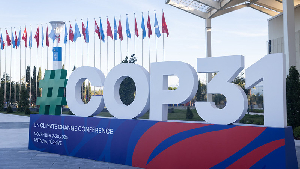 The negotiations collapsed on Sunday, November 22, following more than two weeks of discussions