Ghana’s government is targeting total revenue and grants of GH¢323.4 billion and expenditure of GH¢389.2 billion in 2027, as it seeks to consolidate the gains from two years of fiscal and monetary stabilization while creating greater room for investment in productive capacity, employment and economic transformation.
The fiscal framework, presented to Parliament by Finance Minister Dr Cassiel Ato Forson on Thursday, November 12, 2026 projects an overall cash deficit of GH¢65.8 billion, equivalent to 3.6 percent of Gross Domestic Product (GDP), while setting a primary surplus target of 0.5 percent of GDP.
The budget represents a measured relaxation of the government’s fiscal consolidation programme, with the primary surplus target reduced from 1.5 percent of GDP in 2026 to 0.5 percent in 2027. The adjustment is intended to accommodate increased development expenditure, particularly under the government’s New Economy programme, without abandoning its broader commitment to debt sustainability.
The government is also ruling out new taxes in 2027, relying instead on stronger tax administration, improved compliance, reduced revenue leakages and modernization of existing tax legislation to finance its expenditure commitments.
The central challenge will be whether these revenue-enhancement measures can generate sufficient resources to support an ambitious spending programme while preserving the macroeconomic stability that Ghana has been rebuilding.
Revenue mobilization without new taxes
The revenue target is equivalent to 17.9 percent of GDP and comprises GH¢320.2 billion in domestic revenue and GH¢3.2 billion in project grants.
The largest component will be non-oil tax revenue, projected at GH¢256.1 billion. Non-oil non-tax revenue is expected to contribute GH¢33.5 billion, oil revenue GH¢15.5 billion and other revenue GH¢15.1 billion.
The decision not to introduce new taxes is significant, particularly given the abolition since 2025 of the Electronic Transfer Levy, COVID-19 Levy, emissions levy, withholding tax on betting and lottery winnings, and VAT on motor vehicle insurance.
Instead, the government instead intends to improve collections through modernization of the Income Tax Act and Revenue Administration Act, reforms to stamp duty administration and the Communications Service Tax framework, improved customs administration and the taxation of the digital economy.
It will also review Ghana’s double taxation agreements to address tax evasion and treaty abuse, while strengthening tax dispute resolution and compliance.
The strategy builds on encouraging 2026 results. Between January and October, total revenue and grants reached GH¢219.3 billion, exceeding the corresponding target of GH¢211.8 billion by 3.5 percent. Domestic revenue of GH¢218.2 billion was 4.1 percent above target, with non-oil tax revenue contributing GH¢170 billion.
Nevertheless, the 2027 target will require substantially higher collections, making the effectiveness of administrative reforms, economic expansion and enforcement against tax evasion particularly important.
Capital expenditure takes greater prominence
On the expenditure side, the government has budgeted GH¢389.2 billion, equivalent to 21.6 per cent of GDP.
The largest allocation is GH¢104.1 billion for employee compensation, comprising GH¢92.6 billion for wages and salaries and GH¢11.5 billion for pensions, gratuities and other social contributions.
Interest payments will consume GH¢61 billion, including GH¢51.5 billion on domestic debt and GH¢9.5 billion on external obligations.
Transfers to statutory and earmarked funds are projected at GH¢76.5 billion, while goods and services receive GH¢13.7 billion. Another GH¢17.2 billion is provided for other expenditure, including energy-sector payment shortfalls and transfers to GoldBod. Social benefits account for GH¢2.3 billion.
A particularly significant provision is GH¢100.4 billion for capital expenditure, equivalent to 5.6 per cent of GDP. This comprises GH¢88.4 billion in domestically financed projects and GH¢12 billion in externally financed projects. An additional GH¢13.9 billion is earmarked for arrears clearance, including GH¢4.3 billion for outstanding obligations to independent power producers.
The capital expenditure allocation represents an important change in spending priorities, placing investment in infrastructure and productive assets on a more prominent footing relative to recurrent expenditure. Indeed, presenting the budget proposals, the Finance Minister emphasized that unlike in previous recent years, the capex budget exceeds both the allocation for public sector wages and that for interest payments on the public debt.
The government’s flagship New Economy programme will receive GH¢30 billion, equivalent to 1.5 percent of GDP, in its first year.
This forms part of a four-year (cedi equivalent of) US$10 billion programme covering commercial agriculture, energy infrastructure, critical minerals processing, tourism and creative industries, textiles and garments, pharmaceuticals and bio-manufacturing, and technology.
The wider Big Push infrastructure programme is allocated approximately GH¢28 billion, while education and health receive substantial sectoral allocations.
The government’s intention is to use public investment to attract private capital, expand domestic production, reduce import dependence and increase non-traditional exports.
Deficit financing and debt sustainability
The projected cash deficit of GH¢65.8 billion, or 3.6 percent of GDP, is wider than the expected 2026 outturn. On a commitment basis, however, the deficit is projected lower at GH¢51.9 billion, equivalent to 2.9 percent of GDP.
The corresponding primary surplus is GH¢9 billion, or 0.5 percent of GDP.
This distinction is important because the primary balance excludes interest payments and indicates the extent to which government revenue exceeds expenditure before debt-servicing costs.
The budget provides for net domestic financing of GH¢84.9 billion, alongside a net external financing repayment of GH¢17.7 billion.
The government is also seeking to accelerate debt reduction through early repayment of GH¢29 billion in domestic bonds falling due in February 2027, using resources accumulated in the Cedi Sinking Fund.
Macroeconomic targets and medium-term alignment
The 2027 budget establishes five principal quantitative macroeconomic targets: overall real GDP growth of at least 5.2%; non-oil GDP growth of at least 5.7%; end year inflation of eight percent plus or minus two percentage points – meaning a band of between six percent and 10 percent; a primary surplus on commitment basis of at least 0.5% of GDP; and gross international reserves that can cover at least six months of imports.
These targets are broadly consistent with the government’s medium-term framework for 2027–2030, which envisages overall and non-oil economic growth of at least five percent, inflation within the same eight per cent plus or minus two percentage points band, a primary surplus of at least 0.5 percent of GDP and international reserves covering at least six months of imports.
The 2027 growth targets are however somewhat more ambitious than the medium-term minimums, reflecting the government’s expectation that increased investment will begin to accelerate economic activity net year in particular.
Beyond these immediate targets, the government is ambitiously aiming for real GDP growth of approximately eight per cent and unemployment below eight per cent by 2030, alongside a credible pathway towards investment-grade sovereign creditworthiness.
… and the prospects for achieving them
The prospects for achieving the 2027 targets are supported by a considerably stronger domestic macroeconomic position than Ghana experienced during the recent economic crisis.
Provisional figures presented by Dr Forson indicate that real GDP grew by 6.2 percent in the first half of 2026, while non-oil growth reached 5.9 percent. Both exceeded their respective full-year programme targets of 4.8 and 4.9 percent.
Inflation stood at 5.5 percent in October, while the benchmark Monetary Policy Rate had fallen to 14 percent in September from 21.5 percent a year earlier.
The Ghana Reference Rate, which serves as the base lending rate for commercial banks in Ghana, declined to 10.01 percent in October, from 29.72 percent in January 2025, while average commercial bank lending rates fell to 15.94 percent from 22.2 percent a year earlier.
These developments, together with 35.5 percent annual growth in private-sector credit between August 2025 and August 2026, provide a more favourable environment for investment and economic expansion.
Fiscal performance has also been encouraging, with regards to fiscal consolidation. Between January and October 2026, the primary surplus on a commitment basis reached 1.4 percent of GDP, against a full-year target of 1.5 percent. The commitment-basis overall deficit was just one per cent of GDP, compared with a programmed 3 per cent, while the cash deficit was 2.3 percent against a 4.5 percent target.
Expenditure restraint was instrumental in achieving these results, with commitment-based expenditure 7.6 percent below target. However, combined with a deliberate tight monetary stance by the Bank of Ghana with regards to money supply growth – aimed at curbing demand-pull inflation from cheaper credit pursuing cheaper foreign exchange – this has stifled liquidity in the economy and therefore the demand that can serve as an incentive to produce.
Beyond this there are significant challenges.
First, maintaining revenue growth without new taxes will require sustained improvements in compliance and economic activity. The GH¢256.1 billion non-oil tax target is ambitious, and administrative reforms will take time to deliver their full benefits.
Second, the projected increase in capital expenditure will test the government’s project preparation, procurement and implementation capabilities. Higher budgetary allocations do not automatically translate into completed infrastructure, productive capacity or employment. Moreover, inordinate domestic borrowing could undermine the objective of making credit more affordable for businesses.
Third, the debt and reserves targets will be particularly demanding. Public debt stood at 47.5 percent of GDP in October 2026, meaning that achieving 45 percent in 2027 will require a further reduction despite the government’s substantial investment programme. Gross international reserves, meanwhile, stood at US$12.7 billion, equivalent to 4.5 months of imports at September-end. Increasing this to six months cover will require sustained foreign-exchange inflows, effective international reserve management and continued strength in export earnings, the latter even as the price of gold, which now accounts for two-thirds of those earnings, continues to hover 20% lower than the peak achieved in January this year.
External circumstances will also matter. The IMF’s October 2026 World Economic Outlook projects global economic growth of 3.1 percent in 2026 and 3.4 percent in 2027, while warning of risks from geopolitical conflicts, renewed trade tensions and financial-market uncertainties.
For Ghana, adverse movements in international energy and food prices could raise import costs, undermine inflation reduction and increase pressure on the cedi. Conversely, favourable gold prices, stronger non-traditional exports and improved commodity earnings could support both revenue and reserve accumulation.
Ultimately, the 2027 budget represents a calculated attempt to move Ghana from economic stabilization towards investment-led expansion without relinquishing fiscal discipline.
Its underlying assumptions are supported by encouraging 2026 performance, but achieving the targets will depend on whether the government can translate improved revenue mobilization, controlled expenditure and restored investor confidence into efficiently executed productive investments that create significantly enhanced domestic productive capacity, employment and export earnings.
Business News of Friday, 13 November 2026
Source: businesspostonline.com
Ghana plans to raise GH¢323.4bn and spend GH¢389.2bn in 2027
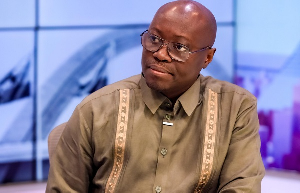 Dr Cassiel Ato Forson is the Minister of Finance