Ghana is expected to sign at least six new petroleum agreements with international oil companies by the first quarter of 2027 as the government intensifies efforts to attract investment and reverse the country's declining crude oil production.
The Minister of Energy and Green Transition, Dr John Abdulai Jinapor, said negotiations with major industry players were progressing as part of an aggressive programme to revitalise the upstream petroleum sector.
Speaking at the Petroleum Commission's 2026 Local Content Conference and Exhibition in Takoradi on Tuesday, November 10, 2026, Dr Jinapor said the government was working to restore investor confidence and create more opportunities for indigenous businesses.
He named Eni, Vitol, Shell, Chevron, Petrobras and ExxonMobil among the major industry players engaged in discussions with Ghana.
The conference, which coincides with the 15th anniversary of the Petroleum Commission, is being held under the theme: “Enriching Local Content for Sustainable Growth: Building a Resilient Upstream Sector Through Reform and Partnership to Spur Competitiveness and Investment.”
Dr Jinapor said local content must be viewed beyond regulatory compliance, describing it as a critical instrument for economic transformation, technology transfer, job creation and the development of globally competitive Ghanaian enterprises.
He disclosed that Ghanaians currently account for approximately 90 per cent of the upstream petroleum workforce, while the value of local content had risen from about $227 million in 2024 to $450 million.
Although he described the progress as encouraging, the minister stressed the need to sustain the gains through increased exploration and production.
Ghana's crude oil production, he noted, had declined consistently since 2020, falling from a peak of approximately 71 million barrels annually to about 37 million barrels.
The decline, he said, had affected economic activities in Takoradi, which had previously benefited significantly from the petroleum industry.
Dr Jinapor said the administration of President John Dramani Mahama had introduced measures to improve policy certainty, predictability and the regulatory environment to make Ghana more attractive to investors.
He announced that Ghana was recording a reversal of the declining production trend for the first time in six years, with daily crude oil output increasing from approximately 90,000 barrels to 122,000 barrels.
However, he said government was determined to move beyond stabilising production to achieving sustained growth, reserve replacement and long-term investment.
The minister identified the Ebano-Afoma field, the Pecan field and the deepwater Keta prospects among the commercially viable discoveries being prioritised for development.
He also announced plans to begin construction of Ghana's third gas processing plant, with a groundbreaking ceremony expected next month.
Dr Jinapor welcomed a Memorandum of Understanding between the Ghana National Petroleum Corporation (GNPC) and Eni, describing the associated gas sales agreement as an important development for the country's energy sector.
He cautioned that Ghana was competing with other African petroleum-producing countries for increasingly limited global exploration capital and could no longer depend solely on its petroleum potential to attract investors.
Business News of Tuesday, 10 November 2026
Source: peacefmonline.com
Ghana targets six new petroleum agreements by Q1 2027 – Jinapor
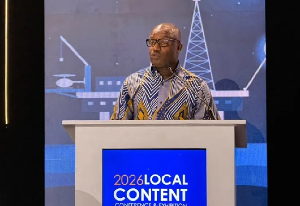 Minister for Energy and Green Transition, Dr John Abdulai Jinapor