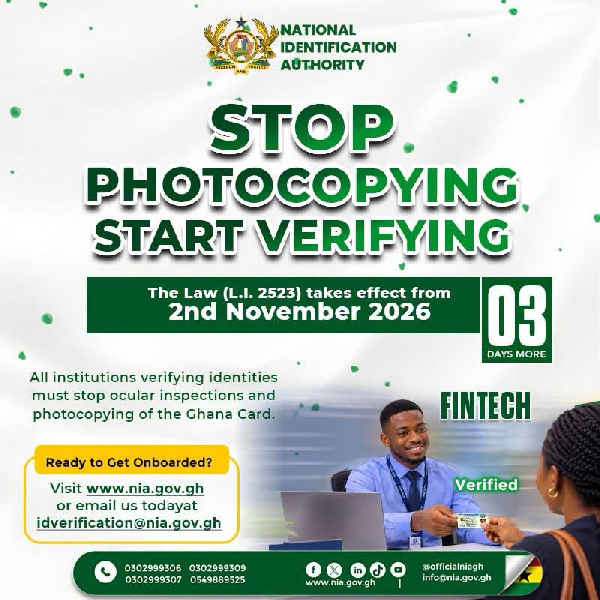
The National Identification Authority (NIA) is set to begin a nationwide crackdown on institutions that continue to photocopy Ghana Cards or rely on visual inspection to verify the identities of customers and clients, effective Monday, November 2, 2026.
The exercise, to be undertaken by the NIA Biometric Verification Taskforce, is aimed at enforcing compliance with the National Identity Register (Amendment) Regulations, 2026 (L.I. 2523), which requires institutions that verify identities to adopt the authority's Identity Verification System Platform (IVSP).
Under the directive, affected institutions are expected to stop the practice of physically inspecting Ghana Cards and making photocopies of them as a means of identity verification. Instead, they must onboard onto the NIA's digital platform to carry out secure biometric verification.
The planned enforcement exercise means institutions that have yet to migrate to the approved verification system will be expected to regularise their operations as the authority moves to strengthen compliance with the new regulations.
The NIA has warned that institutions must comply with the new requirements or risk enforcement action. The directive is expected to affect a wide range of public and private organisations, including banks, telecommunications companies, insurance firms, hospitals, schools and government agencies.
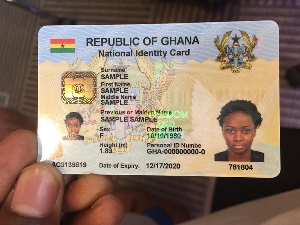
The regulations are intended to address concerns over identity theft, fraudulent transactions and the misuse of personal information. According to the NIA, photocopies and scanned images of Ghana Cards can be altered, duplicated or retained and used without the cardholder's knowledge.
Under the new system, identity verification will involve matching an individual's fingerprints or other approved biometric information against records in the National Identity Register. Approved match-on-card devices may also be used for authentication.
The Minister for the Interior, Muntaka Mohammed-Mubarak, previously explained that the government had introduced a transition period to give institutions time to acquire the necessary equipment, integrate their systems and train personnel ahead of full enforcement.
Institutions that violate the regulations could face fines ranging from 500 to 2,000 penalty units upon summary conviction. At the current value of GH¢12 per penalty unit, this translates into fines of GH¢6,000 to GH¢24,000 for organisations.
Individuals who contravene the regulations could also face fines ranging from 50 to 500 penalty units, equivalent to GH¢600 to GH¢6,000.
The NIA has urged institutions that are yet to integrate with its Identity Verification System Platform to begin the onboarding process immediately.
Organisations can initiate the process through the NIA website, www.nia.gov.gh, or by contacting the authority via idverification@nia.gov.gh.
The November 2 enforcement date marks a major shift in how Ghanaians' identities will be authenticated, ending the widespread practice of photocopying and visually inspecting the Ghana Card as a means of verification.
EA
Business News of Sunday, 1 November 2026
Source: www.ghanaweb.com
NIA targets illegal Ghana Card photocopying in nationwide operation
 The regulations are intended to address concerns over identity theft, fraudulent transactions