Economist Emmanuel Amoah-Darkwah has called on Ghana to make value addition and sustainable job creation central to its investment and trade agreements, arguing that the country can only achieve lasting economic prosperity by moving beyond the export of raw materials.
He said Ghana must deliberately invest in processing its natural resources, including minerals, oil and gas, as well as other locally produced commodities, instead of continuing to export them in their raw state without maximising their economic benefits.
Speaking at the Nyansah Dialogue Series V on October 30, 2026, under the theme "How Does Ghana Protect Its Economic Prosperity in an Age of Strategic Competition?", Amoah-Darkwah stressed that adding value to locally produced resources would enable the country to generate greater revenue, create employment opportunities and build sustainable economic growth.
He observed that Ghana had exported raw materials for decades without adequately developing the industries needed to process them locally and retain more of the economic value.
"What I would want to happen is that we should be able to, first of all, add value to the various things that we produce. Our raw materials, we've been importing them for the past century or so, but we are not getting value for that," he said.
He called for deliberate efforts to add value to minerals, oil and gas, alongside other products produced in the country, describing this as a pathway to lasting national prosperity.
Amoah-Darkwah also identified youth unemployment as a major concern, warning that the challenge has become a national security threat that requires urgent attention.
He urged policymakers to ensure that investment and trade agreements are designed not only to attract capital but also to create sustainable employment opportunities for young people.
Four boys found dead in living room at Wasa Asikuma
"The issue about youth unemployment is real. It is a national security threat," he stated, adding that Ghana must make job creation a priority when entering into investment and trade agreements.
On the growing global demand for critical minerals, the economist noted that the transition towards cleaner energy sources presents Ghana with an opportunity to strengthen its position in the global economy.
However, he argued that the country must invest more in mineral exploration and geological data to improve its negotiating position when engaging international investors and negotiating resource agreements.
According to him, having adequate exploratory data would give Ghana a better understanding of its mineral resources and strengthen its ability to negotiate deals that deliver greater economic benefits to the country.
Meanwhile, policy strategist, researcher and facilitator Marie-Noelle Nwokolo described the dialogue as an engaging platform for exchanging ideas and listening to diverse perspectives.
She highlighted the importance of creating spaces where participants can share experiences, understand different viewpoints and discuss how talent can be effectively managed.
AM
Inside Ghana’s First 950,000-Barrel Sankofa Oil Shipment | Exclusive Tour
“We Can’t Adapt to This New Road Technology” | Ghanaians React to TRAFFITECH-GH
Business News of Sunday, 1 November 2026
Source: www.ghanaweb.com
Economist urges Ghana to prioritise value addition, job creation in trade deals
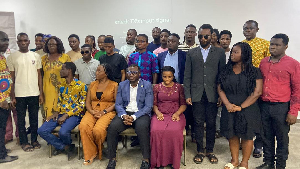 Some of the stakeholders at the event






Opinions