Chief Executive Officer of Intelligence Nature International (INI), Dr William K. Bannerman, has called for clear and consistent climate and Environmental, Social and Governance (ESG) regulations, saying they are essential to attracting investment and strengthening Ghana's competitiveness.
He said uncertainty surrounding the country's evolving climate and ESG regulatory framework could delay investment, increase compliance costs and create difficulties for institutions responsible for implementing the policies, particularly Metropolitan, Municipal and District Assemblies.
Dr Bannerman made the remarks at the Ghana National Climate and ESG Policy Summit 2026, organised by INI at the Mövenpick Ambassador Hotel in Accra on Tuesday, October 27, 2026.
He noted that Ghana's climate commitments under the Nationally Determined Contributions, climate-risk and disclosure requirements in the financial sector, the national carbon market framework and international standards such as the European Union's Carbon Border Adjustment Mechanism were being introduced at the same time.
“Each is important. Together, they can feel like a new language that institutions are expected to speak fluently overnight,” Dr Bannerman said.
He added that unclear regulations could discourage investors and make compliance more expensive for businesses.
“Uncertainty has a cost. When rules are unclear, investment waits, compliance becomes expensive, and the Assemblies, which must ultimately deliver, are left to interpret frameworks with limited staff and limited resources,” he said.
“Clarity, on the other hand, is a competitive advantage. A country that can explain its rules clearly, and apply them consistently, attracts capital and keeps its markets.”
Speaking on the summit's theme, "Decoding Policy and Regulation for the Next Economy", Dr Bannerman said the objective was to translate complex policies into practical guidance that businesses, financial institutions and local authorities could understand and implement.
He stressed the need to align the private sector with Ghana's green transition, noting that businesses must play an active role in the process.
“No transition succeeds if business is a spectator,” he said.
The summit brought together government officials, regulators, local government representatives, bankers, exporters, development partners, diplomats, academics and civil society organisations to discuss Ghana's climate and ESG policy direction.
Dr Bannerman said effective climate action required collaboration among institutions responsible for developing policies, financing the transition and implementing them at the local level.
“No ministry, no regulator, no bank, no company and no Assembly can carry Ghana's transition alone,” he said.
The summit featured three dialogue sessions focusing on regulatory frameworks and localised climate action; capital markets, carbon markets and transition finance; and private sector impact, taxation and local trade compliance.
Each session produced a resolution, which was incorporated into a National Communiqué adopted and signed at the close of the event.
The communiqué was signed by the Minister of State for Climate Change and Sustainability, Seidu Issifu, and the Minister for Local Government, Chieftaincy and Religious Affairs, Mahama Ayariga, with the Association of Ghana Industries and the National Association of Local Authorities of Ghana serving as witnesses.
Closing the summit, Dr Bannerman said the next step was to translate the discussions and resolutions into practical action.
“Today we decoded the rules. The next step is to fund what they require. The work does not end today. It begins today,” he concluded.


Business News of Saturday, 31 October 2026
Source: www.ghanaweb.com
Clear climate and ESG regulations will attract investment to Ghana – INI CEO
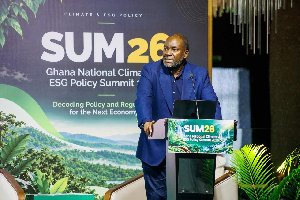 Chief Executive Officer of Intelligence Nature International (INI), Dr William K. Bannerman







Opinions