With the Bank of Ghana’s September 30 deadline having recently passed for microfinance institutions to have submitted fully signed merger, acquisition, or asset/liability transfer agreements, ahead of the final December 31 deadline for recapitalization to at least GHc50 million, the industry is now undergoing severe tension amid uncertainty as to the fate of most of its participating enterprises.
The BoG has not publicly named individual microfinance institutions (MFIs) that have already met the new minimum, successfully finalized mergers or are currently undergoing active consolidation discussions. In line with its standard regulatory oversight under its Mergers and Acquisitions Directive, the central bank handles these structural applications with strict confidentiality.
This prevents public panic, speculative rumors, and sudden deposit runs on undercapitalized institutions while their applications are vetted, Indeed, according to sources within the BoG, it is only now reviewing the submitted agreements and progress updates. The institutions whose plans are approved will have until December 31, 2026, to finalize their capital injection, complete data migration, and achieve full compliance with the BoG’s minimum capital requirement.
But because the framework explicitly states that failure to submit progress reports or signed consolidation agreements by September 30 would trigger immediate operational restrictions and sanctions, industry associations like the Ghana Association of Microfinance Companies (GAMC) have pushed their members toward compliance to avoid pre-emptive shutdowns ahead of the final December deadline.
Privately, industry insiders indicate that the September 30 deadline accelerated a wave of behind-the-scenes restructuring. Rather than facing outright license revocation, multiple smaller tier-scale players have chosen to combine forces or transfer their assets and liabilities to stronger corporate entities.
Because the 11-month runway to jump from the old minimum of just GHc2 million to GH¢50 million is heavily restricted, several standalone microfinance firms are actively engaging in merger talks to combine balance sheets.
At the same time though, rather than pursuing full corporate mergers, many are opting for supervised transfers of assets and liabilities, allowing stronger institutions to absorb their customer bases and performing loan portfolios.
The situation has inevitably created tense uncertainty among the microfinance institutions customers, depositors, investors and borrowers alike, who are already adjusting their behavior ahead of whatever verdicts the BoG will pass on the institutions they maintain accounts with.
Institutional investors, high-net-worth individuals, and everyday depositors are quietly moving their funds out of standalone tier-2 and tier-3 microfinance companies. They are shifting capital into Tier-1 commercial banks or the largest, most visibly capitalized microfinance institutions.
To prevent sudden liquidity shortages, many microfinance firms are matching deposit maturities tightly with loan repayments. As a result, depositors attempting to break fixed deposits early or withdraw large sums are facing stricter withdrawal limits and longer processing times.
Rather than keeping large balances in a single institution, risk-averse depositors are splitting their funds across multiple smaller community banks to maximize their exposure protection under the Ghana Deposit Protection Corporation (GDPC) safety net.
With regards to their loan portfolios, microfinance institutions are actively hoarding cash to shore up their liquidity positions ahead of the final December audit. Consequently, new loan disbursements have slowed dramatically. Long-term capital loans have largely been suspended. MFIs that are still lending are heavily favoring ultra-short-term, micro-turnover loans (such as 30-to-90-day market trader loans) that provide quick, predictable cash inflows.
Loan underwriting standards have tightened significantly. Borrowers who previously qualified for loans based on cash-flow history are now being asked for hard collateral or dual guarantors as institutions try to flush out non-performing loans (NPLs) before regulatory inspectors evaluate their books.
Despite the anxiety, the current landscape is however fundamentally different from the aggressive sector clean-up of 2018–2019. The BoG’s 2026 framework provides safety structures designed to absorb the shock.
Because the BoG is encouraging weak institutions to transfer their assets to healthier ones rather than facing outright liquidation, most depositors will simply see their accounts migrated to a stronger, newly compliant Microfinance Bank come January 2027.
To be sure, the Ghana Deposit Protection Corporation manages the protection of microfinance accounts under the rules of the Ghana Deposit Protection Act, 2016 (Act 931). As licensed Specialized Deposit-Taking Institutions (SDIs), microfinance companies and microfinance banks are mandatory members of the scheme.
However, to prevent depositors from relying solely on the GH¢1,250 baseline safety net, the BoG is steering undercapitalized institutions toward orderly mergers or asset and liability transfers rather than outright liquidations. If an MFI transfers its liabilities to a stronger partner, its customers full balances safely migrate to the new entity under standard banking operations, avoiding a liquidation insurance event entirely.
Business News of Thursday, 15 October 2026
Source: economytimesnews.com
Microfinance firms worried as BoG deadline for recapitalisation passes
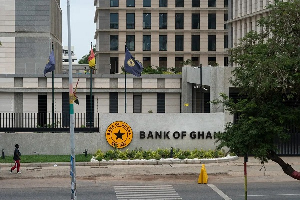 Bank of Ghana (BoG) headquarters