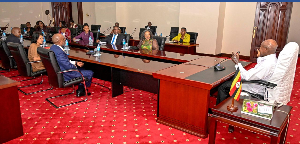
The Head of the Local Government Service (LGS), Professor Lord Kwaku Mensah, has warned local government staff in the Northern Region against absenteeism, indiscipline and partisan political activities in the workplace.
He said public servants must remain at their duty posts during official working hours and demonstrate professionalism, accountability and political neutrality in the discharge of their responsibilities.
Professor Mensah disclosed that he had encountered cases of poor staff attendance during visits to some districts, including three unannounced visits.
He described punctuality, regular attendance and availability to serve the public as non-negotiable responsibilities of local government staff.
The LGS Head made the remarks on Monday, October 5, 2026, when he engaged management and staff of the Northern Regional Coordinating Council (NRCC) in Tamale as part of a five-day tour of the region’s 16 Metropolitan, Municipal and District Assemblies.
He urged the Acting Chief Director of the NRCC, Coordinating Directors and MMDCEs to strengthen measures to enforce discipline and accountability across the various assemblies.
Professor Mensah also cautioned staff against engaging in frontline partisan political activities at the workplace, stressing that political neutrality was fundamental to the public service.
He said public servants were expected to serve all citizens fairly regardless of their personal political affiliations or preferences.
The Head of the LGS further directed staff to adhere to established administrative structures and communication channels when raising concerns or seeking decisions, warning against bypassing immediate supervisors.
Professor Mensah also called for the redistribution of personnel to address staffing imbalances across the assemblies.
He noted that while some departments had more personnel than their operational requirements, others continued to suffer serious staffing shortages.
He identified Social Welfare, Community Development, Births and Deaths and the Department of Agriculture among departments requiring particular attention.
He said efforts to address the staffing gaps must go beyond moving personnel, stressing that affected departments must also be provided with adequate office space, furniture, computers and other logistics to function effectively.
Business News of Thursday, 8 October 2026
Source: kumasimail.com
Avoid absenteeism and partisan politics – Local Government Service chief to staff
 Head of the Local Government Service (LGS), Professor Lord Kwaku Mensah