Ghana’s recent debt crisis should leave the country with one enduring economic lesson: a nation with a substantial pool of domestic savings should not habitually look abroad first whenever it needs long-term capital. International capital has an important role to play, but Ghana’s development financing strategy should increasingly be anchored on mobilizing and recycling its own domestic capital.
The opportunity is considerable. Ghana’s pension industry alone has accumulated tens of billions of cedis in assets. The country’s pension industry assets are reportedly about GHc120 billion – equivalent to well over US$10 billion This is potentially a powerful domestic financing base for infrastructure, productive enterprises and appropriately structured public-sector projects. And importantly, Ghana’s dramatically increased foreign exchange earnings from gold has greatly reduced the need for international debt capital inflows to meet forex shortfalls.
The objective should not be to compel pension funds, insurance companies or banks to finance government. Rather, Ghana needs a deeper capital market capable of producing investment opportunities that make commercial sense for domestic institutional investors.
That means developing longer-dated government securities, infrastructure bonds, municipal and corporate bonds, project-finance instruments, infrastructure funds and equity-market opportunities. Ghana’s Securities and Exchange Commission itself has identified a deeper capital market as strategically important for reducing dependence on external borrowing, financing infrastructure and lowering businesses’ cost of capital.
Such an approach could transform the financing of Ghanaian businesses. Instead of corporations repeatedly seeking foreign-currency loans for projects whose revenues are predominantly in cedis, domestic capital could provide medium- and long-term cedi financing. This would reduce currency mismatches and allow Ghanaian savings to participate directly in the expansion of Ghanaian productive capacity.
The same principle applies to strategic state-managed programmes. The financing of cocoa purchases provides a particularly relevant example. Where the underlying economic activity is domestic—farmers producing cocoa, licensed buyers purchasing beans and a national institution aggregating the crop—there is a strong case for mobilizing a substantial portion of the required financing domestically, rather than automatically resorting to foreign borrowing.
The attraction of foreign capital is understandable. It can provide large volumes of funding relatively quickly and can supplement inadequate domestic savings. But foreign-currency borrowing creates an additional obligation: the borrower must ultimately generate foreign exchange to service it. When export earnings, reserves and exchange-rate stability come under pressure, apparently manageable foreign debt can become exceptionally expensive.
Ghana has experienced the consequences. The country lost international capital-market access amid the fiscal and financial crisis, subsequently undertaking a domestic debt exchange in 2023 and a Eurobond restructuring in 2024. The IMF estimates that more than US$40 billion of debt had been restructured or was under restructuring by June 2026.
The lesson, however, is not that Ghana should abandon international capital markets. It is that external financing should complement, rather than substitute for, domestic capital formation.
There is an important caveat: domestic borrowing can itself become dangerous if government absorbs excessive liquidity, crowds out private borrowers or relies excessively on short-term instruments. The IMF has specifically highlighted Ghana’s rollover risks arising from reliance on short-term domestic financing.
Consequently, Ghana needs not merely more domestic borrowing, but a better domestic capital market—one capable of converting long-term national savings into long-term productive investment.
The ultimate goal should be simple: Ghanaian savings should finance Ghanaian development wherever commercially and financially appropriate. International capital should remain welcome—but increasingly as a partner in development, rather than the country’s first resort for financing its future.
Business News of Thursday, 24 September 2026
Source: economytimesnews.com
Ghana should rely more on domestic savings to finance development – Report
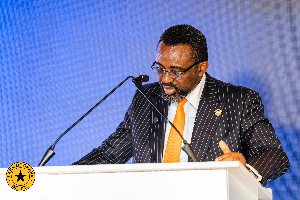 Johnson Asiama is the Governor of BoG


Sports