Banks in Ghana are earning more from fees and commissions, with the income line growing 18.2 percent in the first half of 2026 and increasing its contribution to total industry income.
Bank of Ghana (BoG) data show fees and commissions accounted for 13.4 percent of total banking-sector income in June 2026, up from 10.9 percent in the corresponding period of 2025.
This means more than GH¢13 out of every GH¢100 of income generated by banks came from fees and commissions, compared with about GH¢11 a year earlier.
The growth has occurred as income from traditional interest-based banking has slowed sharply following the decline in market interest rates and government securities yields.
Net interest income contracted by 3.1 percent year-on-year in June 2026, compared with growth of 20.2 percent during the same period in 2025
Banks’ interest spread also narrowed to 4.4 percent from 6.0 percent, while gross yields declined to 6.1 percent from 8.9 percent.
Fees and commissions, however, maintained growth, rising 18.2 percent compared with 17.8 percent in the corresponding period of 2025.
Income from transfers, cards, electronic banking, cash-management services, trade finance, guarantees and other transaction-related services is therefore accounting for a larger part of banks’ revenue.
The latest financial statements of individual banks show significant differences in performance however, although some institutions recorded strong increases.
GCB Bank recorded one of the largest increases in the first half of the year, with net fee and commission income almost doubling to GH¢658.7million from about GH¢332.7million in H1 2025.
The GH¢326million increase represented growth of about 98 percent in one year.
GCB’s overall non-funded income, which also includes trading income, increased about 86 percent to GH¢1.39billion during the period, while net interest income rose 17.3 percent to GH¢2.34billion.
The strong increase in fees and commissions helped the bank grow non-funded earnings at a period when the wider banking industry’s interest margins were narrowing.
Other banks recorded more moderate growth or declines.
Standard Chartered Bank Ghana reported net fee and commission income of GH¢127.23million in the first half of 2026, down from GH¢147.81million in the corresponding period of 2025.
Gross fee and commission income also declined to GH¢139.67million from GH¢156.66million.
Access Bank Ghana similarly recorded a reduction in net fee and commission income to about GH¢246million from GH¢299.5million in the first half of 2025.
The differences show the 18.2 percent industry growth is not being driven by increases across every bank, but by stronger performance at institutions where transaction and other fee-based businesses expanded faster.
Zenith Bank Ghana, for example, also recorded higher fee earnings earlier in the year. Its first-quarter net fee and commission income increased to GH¢112.89million from GH¢83.43million, while gross fee and commission income rose from GH¢96.98million to GH¢127.98million.
The growth in fee income is taking place while overall industry profitability remains under some pressure.
Banks recorded combined profit after tax of GH¢7.1billion in the first half of 2026, down 1.3 percent from GH¢7.2billion in the corresponding period of 2025. Profit before tax also declined by 1.5 percent.
Return on equity fell to 22.9 percent from 32.2 percent, while return on assets declined to 4.4 percent from 5.6 percent.
The composition of industry income has also changed.
Income from investments accounted for 42.8 percent of total income in June 2026, down from 46.4 percent a year earlier, while income associated with loans declined to 28.4 percent from 30.1 percent.
Fees and commissions, in contrast, increased their share to 13.4 percent from 10.9 percent, while other income rose to 15.4 percent from 12.6 percent.
The changes reflect an operating environment in which banks can no longer rely on the exceptionally high returns previously available from government securities and high lending rates to the same extent.
Treasury bill yields have fallen sharply from their levels a year earlier, while average lending rates have also declined as inflation and the BoG policy rate have come down.
The rise in fee and commission income does not necessarily mean individual bank charges have increased.
Banks can generate higher fee income from increased transaction volumes, electronic payments, trade-finance activity, payment cards and expansion in their customer base even where individual charges remain unchanged.
The figures nevertheless show fee-based business is accounting for a larger share of bank earnings as returns from interest-bearing assets moderate.
Business News of Wednesday, 16 September 2026
Source: economytimesnews.com
Ghana banks earn more from fees as interest income falls
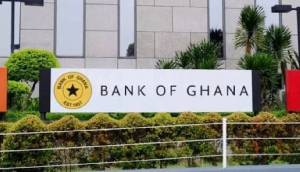 The Bank of Ghana (BoG)