The Ghana Cocoa Board (COCOBOD) has barred Licensed Buying Companies (LBCs) from purchasing cocoa beans from farmers on credit, warning that companies that breach the directive risk losing their operating licences.
Chief Executive Officer of COCOBOD, Dr Randy Abbey, disclosed this at the launch of the Chamber of Cocoa Marketers, saying the regulator has formally instructed LBCs to end the practice as part of measures to strengthen liquidity, improve payment discipline and restore efficiency across Ghana’s cocoa supply chain.
Dr Abbey said COCOBOD has already communicated the directive to LBCs and cautioned that any repeat violation could result in the revocation of their licences.
“The arrangement is to aid the shorter turnaround time for LBCs so that it can quicken the pace of purchases, eliminate indebtedness to banks and improve the efficiency and profitability of cocoa purchases.
“We have met as part of our stakeholder engagements. I have told them you are not supposed to buy cocoa on credit from farmers. We have all decided that we will go and sin no more,” he said.
He added that while COCOBOD was not immediately withdrawing any licences, companies that disregard the directive in future would face sanctions.
“So we are not withdrawing anybody’s licence. But we have written to the effect that if it happens again, your licence will be revoked because it is against the terms of your licence.
“We have also told the farmers that LBCs are not supposed to buy cocoa on credit from you. So don’t go and take your cocoa to any purchasing clerk on credit,” Dr Abbey said.
New financing model
The directive comes as COCOBOD prepares to overhaul the financing of cocoa purchases, with a new funding model expected to provide sufficient liquidity for crop purchases and related operations throughout the year.
Dr Abbey said the model, which is expected to take effect from the 2026/27 crop year, is intended to eliminate delays in payments to LBCs after they take over cocoa receipts from farmers.
“The new funding model is to ensure sufficient liquidity for cocoa purchases and related operations all year round. Hence, beginning the 2026/27 crop year, we hope to eliminate the delays in the payment of cocoa taking-over receipts, which has been the bane of LBCs since 2020,” he said.
According to him, faster payment cycles will enable LBCs to accelerate purchases, reduce their indebtedness to financial institutions and improve the efficiency and profitability of cocoa marketing.
Boosting local processing
The COCOBOD CEO said the financing reforms are also critical to increasing domestic cocoa processing and value addition.
He explained that the previous funding structure required much of Ghana’s cocoa crop to be collateralised to secure financing, limiting access to raw beans for local processors.
The new financing mechanism, he said, is therefore intended to provide adequate liquidity for cocoa procurement while supporting Ghana’s ambition to retain more value from its cocoa production domestically.
2026 Cocoa Board Bill
The reforms form part of the new Ghana Cocoa Board Bill 2026, which Dr Abbey said guarantees cocoa farmers 70% of gross Free on Board (FOB) value while allowing producer prices to be adjusted during the season in line with market indicators.
He said the broader reforms are aimed at improving the financial viability of the cocoa sector, strengthening the value chain and delivering more sustainable returns to farmers and other industry stakeholders.
“These measures and the new bill constitute the most significant reforms to our industry since 1984. So the COCOBOD Act, until Parliament passed this new one, was a 1984 Act.
“These reforms are resetting the cocoa sector for growth and industrialisation,” he stressed.
Business News of Friday, 14 August 2026
Source: otecfmghana.com
COCOBOD bans LBCs from buying cocoa from farmers on credit
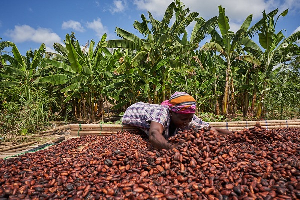 File photo of a cocoa farmer with cocoa beans