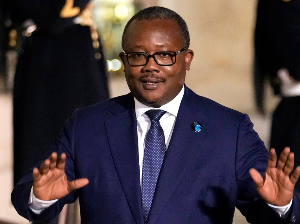
Government Statistician Alhassan Iddrisu has revealed that Ghana’s economic growth slowed to 5.1 percent year-on-year in May 2026, compared with the 6.6 percent recorded during the same period in 2025.
According to the latest Monthly Indicator of Economic Growth (MIEG) released by the Ghana Statistical Service (GSS) on Thursday, August 13, 2026, the overall MIEG index increased to 121.9 in May 2026 from 115.9 in May 2025, using 2023 as the base year.
The figures indicate that while the economy continued to expand in real terms, the pace of growth moderated during the period.
Ebi Bright orders halt to TDC construction works in Tema over permit breaches
“Slower growth is not a fall. The economy is still bigger than it was a year ago, it is simply expanding at a gentler pace,” the statement noted.
The services sector remained the main driver of economic activity, recording a year-on-year growth rate of 7.2 percent.
The growth was largely supported by strong performances in information and communication, trade, transport and financial activities.
Services accounted for 51.0 percent of total economic growth in May, contributing more than half of the overall expansion recorded during the month.
The industrial sector, meanwhile, grew by 4.2 percent, slightly lower than the 4.6 percent recorded in May 2025.
The sector’s performance was driven mainly by sustained activity in mining and quarrying and accounted for 23.8 percent of the total 5.1 percent growth.
“Industry expanded... driven mainly by mining and quarrying. That is broadly unchanged from 4.6 percent a year earlier, a stable performance,” the report highlighted.
Agriculture recorded the sharpest slowdown, with growth falling to 3.6 percent in May 2026 from 9.8 percent in the corresponding period last year.
The GSS said crops and livestock continued to lead agricultural activity but noted that the lower growth rate was partly due to the high base recorded in the previous year.
Agriculture contributed 21.2 percent to overall growth, while net indirect taxes accounted for the remaining 4.0 percent.
The report, however, warned that the slowdown in agriculture requires urgent attention, particularly because of its potential implications for food prices, rural incomes and export earnings.
“Growth is holding up [and] average incomes can keep rising. But growth is narrowing, just over half of all growth now comes from one sector. Agriculture needs attention; a fall from 9.8% to 3.6% reaches straight into food prices, rural incomes and export earnings,” official insights from the release stressed.
Iddrisu said the monthly growth indicators serve as a high-frequency early warning system for policymakers, providing timely signals on economic conditions ahead of the release of quarterly GDP figures.
The report therefore urged the government and the Bank of Ghana to incorporate the monthly indicators into budget execution reviews and monetary policy decisions.
It also called for targeted interventions in agriculture, including the provision of inputs, irrigation infrastructure and storage facilities, to support productivity and sustain growth.
Businesses operating in the services sector are encouraged to take advantage of growing demand in digital and communication-related activities.
ANAS/MA
Ghana's recovery due to superior economic management - Ato Forson
Business News of Thursday, 13 August 2026
Source: www.ghanaweb.com
Ghana's economic growth eases from 6.6% to 5.1% in May 2026
 Alhassan Iddrisu is a Government Statistician in Ghana