The International Monetary Fund (IMF) has estimated that the Bank of Ghana incurred about $1.7 billion in balance-sheet losses under its Domestic Gold Purchase Programme (DGPP), quantifying the financial cost of a reserve-building strategy that helped lift Ghana’s international reserves to record post-crisis levels and supported the cedi’s emergence as the world’s best-performing currency in 2025.
Bank of Ghana data show that gross international reserves increased from $10.30 billion in March 2025 to $13.83 billion by December, raising import cover from 4.5 months to 5.7 months.
Programme-defined international reserves under the IMF-supported programme also rose from $7.70 billion to US$11.91 billion over the same period, giving the central bank greater capacity to support the foreign exchange market.
The larger reserve buffer strengthened the Bank of Ghana’s capacity to manage the foreign exchange market.
With more reserves at its disposal, the central bank was better positioned to supply foreign exchange during periods of heightened demand, support market liquidity and reassure investors of Ghana’s ability to meet its external obligations without placing additional pressure on the cedi.
The improvement in reserves formed part of a broader macroeconomic recovery that transformed the cedi’s performance. After coming under severe pressure during the economic crisis, when the currency traded above GH¢16 to the US dollar in late 2022, the cedi appreciated 40.7 percent against the US dollar in 2025, emerging among the world’s strongest-performing currencies.
The recovery reflected tighter monetary policy, fiscal consolidation, stronger export earnings and renewed investor confidence, with the larger reserve buffer providing additional support to foreign exchange market stability.
The reserve accumulation also coincided with a marked improvement in Ghana’s external accounts.
Total exports reached $31.25 billion in 2025, driven largely by gold exports of $20.98 billion, while the country recorded a $13.80 billion trade surplus and a US$9.39 billion current account surplus.
Together, those developments strengthened Ghana’s external position, reduced pressure on the foreign exchange market and reinforced the gains made through reserve accumulation.
The finding also explains why Ghana is changing the institutional model behind the strategy. While the Fund acknowledged the role domestic gold purchases played in strengthening reserve buffers, it argued that the commercial and valuation risks associated with buying and trading gold should no longer sit on the Bank of Ghana’s balance sheet.
The IMF’s assessment suggests the Domestic Gold Purchase Programme should not be viewed solely through the lens of the $1.7 billion balance-sheet loss.
While the programmeimposed a measurable financial cost on the central bank, it also coincided with a significant strengthening of Ghana’s reserve position and broader improvements in the country’s external accounts during the economic recovery.
The experience has also reshaped Ghana’s approach to reserve management. Rather than abandoning domestic gold purchases, policymakers have chosen to separate reserve accumulation from commercial gold trading, allowing the central bank to focus on monetary policy while a specialized institution assumes the operational and commercial risks associated with buying and selling gold.
The transfer of domestic gold purchases to GoldBod marks the biggest change to Ghana’s reserve accumulation strategy since the programme began.
While the Bank of Ghana steps back from commercial gold trading, the objective of using domestic gold to strengthen the country’s external reserve position remains unchanged.
Business News of Tuesday, 11 August 2026
Source: economytimesnews.com
BoG gold programme boosts Ghana’s reserves despite $1.7 billion loss - Report
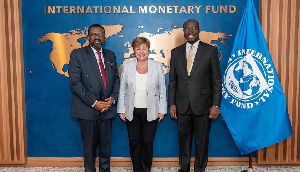 BoG Governor Asiama (L), IMF MD Kristalina Georgieva (M) and Finance Minister Ato Forson (R)