The Bank of Ghana’s withdrawal of GH¢8.48 billion from the financial system through its 14-day bill auction of Wednesday, August 5, representing a 48.83 percent reduction from the GH¢16.57 withdrawn on July 27, is being seen by bank treasurers and monetary economists alike as a sign that the central bank’s new liquidity management strategy is working.
Indeed they point further back to the fact that the August 5 amount was also 8.37 percent below the GH¢9.25 billion absorbed at the tender of July 22 and 27.41 percent below the GH¢11.68 billion sold at the tender on July 15. These amounts are significantly lower than the GH¢14.42 billion withdrawn through its 14 day bills earlier, on July 6.
The decreases in the amounts absorbed (albeit with the notable exception of the July 27 auction) represent a significant moderation in the scale of the BoG’s liquidity sterilization.
The central bank enthuses that the recently introduced format, by which the erstwhile dynamic Cash Reserve Ratio (CRR) for commercial banks was replaced with a uniform 20 percent CRR, has proved successful so far.
“Since the transition to a uniform 20 percent CRR on 4 June 2026, we have observed a significant reduction in the stock of Open Market Operations (OMO) due to banks’ non-rollover of OMO bills to meet the statutory CRR” the BoG has revealed in an official statement. “The move from a dynamic to a uniform CRR has simplified the regulatory framework, allowing banks to plan and provision for the CRR.”
“Since its introduction, the Bank has been closely monitoring liquidity conditions, money market rates, credit activity, and the foreign exchange market” the BoG further states.
“Early assessments indicate that the transition has been orderly, with banks generally complying with the revised requirement and the banking system remaining sufficiently liquid. The new CRR policy ensures that liquidity conditions stay aligned with the Bank’s inflation expectations and the goals of our foreign exchange operations.
The central bank explains that at the time of the transitioning, 17 of the 23 banks were already provisioning at an effective CRR of 25 percent under the dynamic CRR framework. Only six banks were operating below that level, three at 20 percent and the other three at 15 percent.
The BoG had projected that a minimum of about GH¢11.5 billion would be absorbed from the market through the implementation of the new uniform 20 percent CRR, maintained in domestic currency, at no cost to the central bank itself.
The observed decline in BoG securities of about GH¢10.6 billion shortly after the implementation date, together with other liquidity withdrawals, suggests that the projected liquidity absorption target was largely achieved, in aggregate terms.
The BoG’s transition to a uniform CRR marks an important shift in the way it sterilizes excess liquidity in the banking system. Rather than relying primarily on interest-bearing Bank of Ghana (BoG) bills issued through Open Market Operations (OMO), the central bank is now placing greater emphasis on non-interest paying reserve requirements as a structural liquidity management tool.
The result is a gradual reduction in the volume of BoG bills that need to be issued to commercial banks, lowering one of the central bank’s fastest-growing operating costs while preserving its ability to influence monetary conditions.
Under the dynamic CRR regime introduced in 2025, reserve requirements varied across banks according to their liquidity positions and balance-sheet expansion.
While effective in absorbing excess liquidity, the framework became increasingly complex to administer and less predictable from the perspective of commercial banks. The BoG’s Monetary Policy Committee therefore opted for a simpler arrangement: every bank must now maintain a uniform CRR of 20 percent in domestic currency.
The mechanics are straightforward. Every cedi impounded through a non-interest-bearing CRR is one less cedi that the Bank of Ghana needs to sterilize by issuing an interest-bearing BoG bill. Since reserves lodged with the central bank earn no interest, whereas BoG bills require the payment of interest to banks, shifting liquidity absorption towards CRR directly reduces the central bank’s financing costs.
The importance of this cost reduction has grown in recent years. As liquidity expanded through stronger deposit growth, foreign exchange accumulation, gold purchases under the central bank’s reserve-building strategy and improved fiscal conditions, the BoG increasingly had to mop up surplus liquidity through BoG securities.
Although these operations were necessary to keep overnight money-market rates aligned with the policy rate and prevent excess liquidity from fuelling inflation or speculative foreign exchange demand, they imposed significant quasi-fiscal costs on the BoG’s own balance sheet. Bank officials have acknowledged that while sterilization costs are unavoidable in pursuing price stability, a balanced mix of remunerated and non-remunerated instruments is preferable.
This explains why the uniform CRR should gradually reduce the central bank’s dependence on BoG bills rather than eliminate it altogether.
The reduction in the effective tenor of BoG bills has reinforced this transition. Traditionally, the Bank relied primarily on 56-day BoG bills as its principal OMO instruments. More recently, operations have become concentrated in the shorter 14-day maturity, with longer maturities used more selectively.
A shorter tenor gives the central bank considerably greater flexibility because liquidity conditions can change rapidly following government expenditure, tax collections, cocoa financing, foreign exchange interventions or seasonal banking flows.
Fourteen-day securities enable the Bank to recalibrate liquidity every fortnight rather than locking itself into higher-cost sterilization for nearly two months. If banking system liquidity tightens unexpectedly, maturing bills simply need not be rolled over. Conversely, should liquidity surge, new bills can quickly be issued. This substantially reduces the risk of over-sterilizing or under-sterilizing the financial system.
From a cost perspective, shorter maturities also limit the duration over which interest obligations accumulate. Although refinancing occurs more frequently, the Bank retains the flexibility to reduce auction volumes whenever structural liquidity has already been absorbed.
There are already indications that this combination of a higher structural reserve requirement and shorter-term market operations is changing the composition of liquidity management. Instead of relying on BoG bills to absorb both permanent and temporary liquidity, reserve requirements now absorb the structural component while 14-day bills address temporary fluctuations around that structural position.
The implications for inflation control are broadly positive. Excess banking system liquidity has historically found its way into three principal channels: rapid domestic credit expansion, heavy investment in government securities and increased foreign exchange demand. While stronger lending is desirable when it finances productive investment, excessive liquidity can generate inflationary pressures if credit grows faster than productive capacity. Similarly, abundant liquidity frequently spills into the foreign exchange market, increasing demand for dollars and weakening the cedi.
By immobilizing 20 percent of banks’ deposits before they can be deployed elsewhere, the CRR automatically dampens these pressures without requiring continuous interest payments by the central bank. Meanwhile, the continued availability of 14-day BoG bills allows the Bank to fine-tune liquidity whenever market conditions warrant.
On the other hand though, a permanently higher CRR effectively acts as a tax on banking intermediation because the impounded reserves cannot be used for lending or investment and receive no remuneration. Banks therefore face higher opportunity costs, which may partly be passed on through wider lending spreads or tighter credit standards.
Business News of Friday, 7 August 2026
Source: businesspostonline.com
New liquidity framework eases need for BoG bills
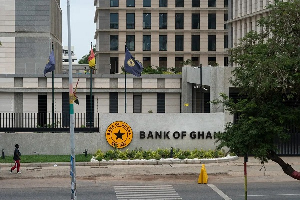 The Bank of Ghana headquarters