Executive Secretary of the Chamber of Petroleum Consumers (COPEC), Duncan Amoah, has argued that the Government of Ghana has the power to influence petroleum prices if it chooses to do so, insisting that repeated references to global market forces are often used as excuses for rising fuel costs.
Speaking in an interview on TV3 on Friday, August 7, 2026, Amoah maintained that while international crude oil prices and geopolitical tensions have an impact on global fuel markets, governments can implement policies to shield citizens from the full effects of price shocks.
"I said again that government has an absolute control over petroleum pricing if it decides it wants to. If it decides it doesn't want to, then the excuses will come forth where government says, 'Oh, well, this is international market price,'" he said.
Gov't recovers nine forest reserves from galamsey invasion – Yusif Sulemana
Responding to suggestions that Ghana's fuel prices are primarily driven by international market conditions, Amoah acknowledged the influence of global events but argued that other countries facing similar challenges have managed to keep fuel prices relatively lower.
"The same international markets exist, and yet other countries, even where the wars are happening, are still able to deliver cheaper fuel prices relative to what we sell to our people," he stated.
According to him, Ghana's inability to cushion consumers against rising fuel prices is the result of inadequate planning rather than solely external factors.
"It is not largely because of those wars, but because we failed to plan for our people. We sit and allow anything," he remarked.
Using a football analogy, Amoah likened Ghana's petroleum pricing framework to a football team without a goalkeeper, arguing that the country lacks the necessary mechanisms to protect consumers during periods of global price volatility.
"You saw the World Cup that just went by. No matter how good Spain or Argentina were, if you took out the goalkeeper from the goalpost, the defenders cannot do much because any ball at all from any angle will probably end up in the goal. That is exactly the kind of system we have now," he explained.
He added that Ghana currently has no effective buffer to absorb sharp increases in international petroleum prices.
"The goalposts are empty. We do not have a single buffer that you and I can fall on when international market prices rise steeply due to geopolitical issues," he said.
Amoah further argued that successive governments have become price takers, simply transferring increases in global fuel prices directly to consumers.
"Whatever happens in Ukraine or Russia, the politician will be quick to tell you that you should pay more for fuel in Ghana. What is my business with what Russia and Ukraine do thousands of miles away from me?" he questioned.
He concluded by stressing that the country's dependence on international pricing leaves consumers vulnerable to external shocks.
"We continue to be price takers. We continue to accept whatever the international markets throw at us. We will continue to pass it on," Amoah stated.
ANAS/MA
Ghana's recovery due to superior economic management - Ato Forson
Business News of Friday, 7 August 2026
Source: www.ghanaweb.com
'Government can cushion fuel consumers if it wants to' - Duncan Amoah
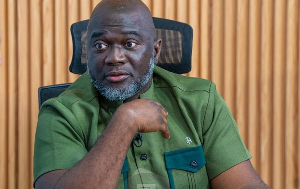 Duncan Amoah is the Executive Secretary of COPEC