Credit extended by banks to businesses and households grew by more than 41% in June 2026, up sharply from about 9% recorded a year earlier, the Bank of Ghana (BoG) has disclosed.
The significant increase in private-sector lending is being attributed to improved economic confidence and declining lending rates, which have made it easier for businesses and households to access financing.
Governor of the Bank of Ghana, Dr Johnson Pandit Asiama, disclosed this on Wednesday, August 5, 2026, during a stakeholder engagement with the business community in Sunyani.
IMF calls on BoG to stop quasi-fiscal activities amid GH¢22bn gold losses
According to him, the strong growth in credit is an indication that the banking sector is increasingly supporting economic activity as Ghana's macroeconomic conditions improve.
“Most importantly, banks are lending more to the private sector. Credit to businesses and households grew by more than 41 percent in June this year, compared with about 9 percent a year earlier,” Dr Asiama said.
He said the increased availability of credit would provide businesses with the resources needed to expand their operations, create jobs and contribute to economic growth.
“This means more businesses have access to financing to expand, create jobs and contribute to economic growth,” he added.
Dr Asiama also noted that lending rates had fallen, making it easier for businesses to secure financing for investment and expansion.
“Lending rates have fallen, making it easier for businesses to access credit and invest,” he said.
The Governor said the increase in lending was occurring against the backdrop of continued economic expansion, with Ghana’s economy growing by 6.4% in the first quarter of 2026, compared with 6.2% during the same period in 2025.
He said the growth was driven mainly by the services and industrial sectors, with increased activity also recorded in trade, industrial production and tourism.
“Just as importantly, businesses and consumers are becoming more confident about the future,” Dr Asiama said.
Dr Asiama further described Ghana’s banking sector as strong and stable, noting that banks remained well-capitalised, deposits continued to grow and the quality of bank loans had improved.
The Monetary Policy Committee recently maintained the Monetary Policy Rate at 14%, a decision Dr Asiama said was intended to strike a balance between controlling inflation and supporting businesses, investment and economic growth.
On the external sector, the Governor said Ghana’s foreign exchange position remained resilient, supported by strong exports of gold and cocoa.
He said the country recorded a higher trade surplus in the first half of 2026, while foreign exchange reserves stood at about US$12.9 billion, equivalent to five months of import cover.
“These reserves give us a strong buffer against external shocks and help the Bank of Ghana support stability in the foreign exchange market,” he said.
Dr Asiama acknowledged that the cedi came under pressure earlier in the year due to global developments, particularly the conflict in the Middle East, but said the currency had since recovered.
He assured stakeholders that the central bank remained committed to maintaining an orderly and well-functioning foreign exchange market.
The Governor, however, cautioned that Ghana could not afford to become complacent amid uncertainty in the global economy.
He said the BoG would continue to focus on protecting the value of the cedi, keeping inflation low, preserving financial stability and supporting sustainable economic growth.
Business News of Thursday, 6 August 2026
Source: www.ghanaweb.com
Credit to businesses, households jumps 41% – BoG Governor
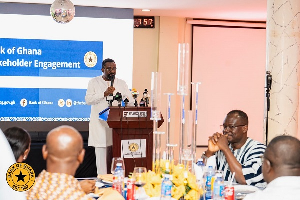 BoG Governor, Dr Johnson Pandit Asiama