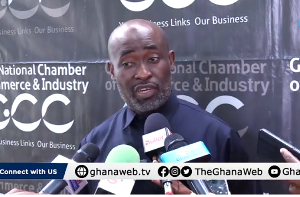
The President of the Ghana National Chamber of Commerce and Industry (GNCCI), Stephane Miezan, has urged government to ensure the effective implementation of the 24-Hour Economy policy, stressing that Ghana has all the resources needed to industrialise but requires the right policies and stronger collaboration with the private sector.
Speaking to journalists after the CEOs Business Forum on the 24-Hour Economy on Tuesday, July 14, 2026, Miezan said Ghana could draw lessons from development models adopted by countries such as China and the United Arab Emirates.
Dr Jinapor to pitch Ghana's $3.5bn energy investment drive at African Energy Week 2026
According to him, while China built its economy through industrialisation, Dubai achieved remarkable growth through the services sector.
"There are two particular models of development, the China model and the Dubai model. China has developed based on industrialisation, while Dubai has developed based on services," he said.
He argued that Ghana is well-positioned to pursue an industrialisation agenda due to its abundant agricultural resources, mineral wealth and petroleum reserves.
"Ghana has everything to develop through industry. You have agriculture, you have natural resources, you have petroleum, everything you want to talk about. If Ghana wants to develop, we can follow the Chinese model, which is industry," he noted.
Miezan, however, emphasised that the success of any development strategy depends on implementation rather than policy announcements.
He noted that successive governments have introduced major economic initiatives, including the Ghana Beyond Aid agenda, the Better Ghana Agenda, the One District, One Factory (1D1F) programme and now the 24-Hour Economy policy.
"We've had Ghana Beyond Aid, we've had the Better Ghana Agenda, we've had the One District, One Factory policy, and now we have the 24-Hour Economy policy. The question is, how effective has the implementation been?" he asked.
He explained that the CEOs Business Forum was organised to help the private sector better understand the 24-Hour Economy programme and how businesses can participate in its implementation.
According to him, officials from the 24-Hour Economy Secretariat were invited to engage directly with businesses, while financial institutions were also brought in to explain available funding opportunities for small, medium and large enterprises.
"We have brought the 24-Hour Economy Secretariat to speak to the private sector so that we can better understand the policy and ensure it does not become another initiative that fades away," he said.
He stressed that access to finance remains critical if Ghanaian businesses are to expand production and support the country's industrialisation drive.
"We also brought the banks to explain the avenues through which Ghanaian industries and companies can access funding, because at the end of the day, we need to industrialise our country," he added.
Miezan said industrialisation remains the most sustainable pathway to creating employment, especially for the thousands of young people graduating from Ghana's educational institutions each year.
He noted that while Ghana continues to export skilled professionals such as nurses and teachers, greater attention must be given to creating opportunities for those seeking careers in manufacturing and industry.
"We need to create jobs for our people. Ghana trains more than 120,000 students every year. We are exporting nurses and even teachers, but what about those who want to go into industry? Where are the jobs for them?" he asked.
The GNCCI President also urged businesses to take advantage of opportunities created under the African Continental Free Trade Area (AfCFTA), whose Secretariat is hosted in Ghana.
According to him, Ghana must leverage its strategic position to expand industrial production and increase exports across the continent.
He welcomed the decision to make the 24-Hour Economy a long-term national policy, expressing optimism that future governments would continue implementing it regardless of political transitions.
"I was happy to hear that this is a policy that has been assented to and that no new government is going to change it. Ghana needs policy continuity if we are to achieve industrialisation," he said.
Miezan said the Chamber remains committed to engaging government to ensure businesses fully understand the policy and are well-positioned to benefit from its implementation.
"This is a country that we all love. As President of the Chamber of Commerce, we want to engage, understand the benefits of the policy and ensure the private sector can tap into the opportunities it offers," he noted.
ANAS/MA
Ghana should emulate China's development model – GNCCI President
Business News of Wednesday, 15 July 2026
Source: www.ghanaweb.com