The Bank of Ghana (BoG) has defended the cedi’s underlying strength and urged market participants to avoid speculative positions against the currency.
The central bank argued that stronger external buffers, improving macroeconomic conditions and sustained policy discipline continue to support exchange rate stability despite recent pressures.
The caution comes as the cedi faces renewed demand pressures. By the end of last week, the local currency had depreciated 0.94 percent week-on-week against the U.S. dollar while weakening 0.70 percent against the British pound and 1.24 percent against the euro. Year-to-date losses against the dollar widened to 10.14 percent.
Speaking at the Money Summit 2026 organised by Business and Financial Times in Accra, Second Deputy Governor Matilda Asante-Asiedu said recent market pressures do not justify speculative attacks on the currency.
“The fundamentals of this economy do not deserve speculation against our currency,” she said, urging banks, importers, exporters and investors to transact based on genuine business needs rather than fear-driven foreign exchange demand.
The central bank has remained active in the foreign exchange market, supplying a cumulative US$250million through its regular auctions last week.
However, demand continued to outpace supply, with bids reaching US$518million and US$485million respectively. Auction clearing rates also moved higher to between GH¢11.68 and GH¢11.73 per dollar, reflecting persistent demand pressures.
BoG supplied a total of US$1billion to the market in May and has announced plans of increasing interventions to US$1.2billion in June to support liquidity conditions.
Asante-Asiedu attributed part of the pressure on the foreign exchange market to higher energy import costs and geopolitical developments.
She disclosed that Ghana has been required to provide nearly 40 percent more foreign exchange to finance oil imports amid disruptions linked to the U.S.-Iran conflict.
Despite these challenges, she said, the country’s reserve position remains strong. Gross international reserves rose to US$14.4billion as of May 18, 2026; equivalent to 5.7 months of import cover compared with US$13.8billion at the end of 2025.
The current account surplus also improved to US$3.10billion in the first quarter of 2026 from US$2.43billion a year earlier, supported by strong gold and cocoa export earnings and resilient remittance inflows.
“Our buffers have held strong and the market has stayed largely open,” she said, noting that the central bank’s rules-based foreign exchange intervention framework has helped smooth volatility while preserving market confidence.
The deputy governor also highlighted broader macroeconomic improvements, including the decline in inflation from 23.8 percent at the end of 2024 to 23.4 percent in April 2026.
Over the same period, the monetary policy rate fell from 27 percent to 14 percent, Treasury bill rates declined from about 28 percent to below 5 percent and average lending rates eased to around 16 percent.
She nevertheless cautioned that the gains remain vulnerable if policy discipline is not maintained, particularly as Ghana transitions from the IMF Extended Credit Facility programme to a Policy Coordination Instrument.
“The numbers, good they are, are however fragile if they are not anchored,” Asante-Asiedu said.
“Our credibility now rests entirely on the quality and consistency of our policies.”
The Bank of Ghana plans to continue building reserve buffers through the Ghana Gold Reserve Accumulation Programme (GAMRAP), targetting reserves equivalent to 15 months of import cover over the medium-term.
The central bank also expects stronger bank balance sheets and deeper domestic capital mobilisation to support credit growth for agriculture, manufacturing and small businesses.
“We have secured stability,” she said.
“Our charge now is to sustain it.”
Business News of Wednesday, 3 June 2026
Source: thebftonline.com
BoG defends cedi fundamentals, cautions against currency speculation
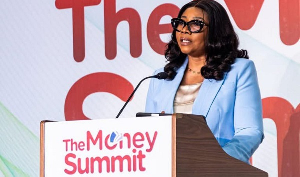 Matilda Asante-Asiedu is the Second Deputy Governor