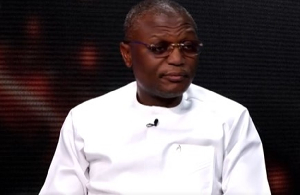
Edward Effah, founder of Fidelity Bank Ghana, has proposed the establishment of a National Economic Transformation Council, chaired by the President, to drive reforms and accelerate Ghana’s economic transformation and industrialisation agenda.
He said the council should be responsible for setting national economic targets, fast-tracking reforms, and monitoring implementation to ensure sustainable growth and competitiveness.
Effah made the proposal at the 10th Ghana CEO Summit in Accra, held on the theme, “The CEO-Government Compact 2026: Accelerating Ghana’s Economic Transformation.”
He also proposed the creation of a professionally staffed Transformation Delivery Unit, organised around strategic sectors such as agribusiness, technology and digitalisation, industry and manufacturing, energy and infrastructure, and financial services.
According to him, the unit should be established through an Act of Parliament to ensure continuity beyond any single administration.
Effah said Ghana could draw lessons from successful development models such as Singapore’s Economic Development Board and Rwanda’s Development Board.
He emphasised the need for a structured and ambitious partnership between government and the private sector to remove bottlenecks and ensure sustainable economic growth.
Effah noted that Ghana had made significant gains in macroeconomic stability and was well-positioned to take advantage of emerging opportunities.
“There is a tide in the affairs of men, which, taken at the flood, leads on to fortune,” he said.
“The tide is here. We have macroeconomic stability, demographic pressure, a regional opportunity, a technology window, and a government willing to lead. We can either seize this moment or watch it pass.”
Effah highlighted the progress Ghana has made, noting that the country’s GDP had grown from US$56 billion in 2016 to an estimated US$115 billion today, making it the eighth-largest economy in Africa.
He added that inflation currently stands at 3.3 per cent, while gross international reserves have reached US$13.8 billion, describing the achievements as “remarkable and hard-won.”
Despite the progress, he said major challenges remain, particularly youth unemployment.
“Today, there are 1.5 million young Ghanaians who are not in employment, education, or training,” he said.
Effah stressed that closer collaboration between the private sector and government is critical to creating jobs and transforming the economy.
“To transform our economy and create jobs, we, the private sector, and the government urgently need to work together,” he added.
He called for the mobilisation of approximately US$25 billion over the next five years to invest in priority sectors.
According to him, this should be achieved through a blended financing model involving commercial banks, local development finance institutions, international development finance partners, and direct investors.
“If we are to absorb half a million new labour market entrants each year, sustain seven to 10 per cent economic growth, and double our export base, the investment envelope must be of that order of magnitude,” he said.
Effah cited the COVID-19 Private Sector Fund, led by Fidelity Bank, as an example of successful private-sector mobilisation, noting that it raised GH¢48 million and delivered the Ghana Infectious Disease Centre within 100 days.
He also referenced the Energy Sector Levies Act, which helped address approximately GH¢10 billion in sector debt, as evidence of what can be achieved through coordinated action between government and the private sector.
“With a clear transformation agenda that identifies priority areas, investment needs, and returns for investors, the private sector will step up, work with government, and deliver, as it always does,” Effah said.
Business News of Sunday, 31 May 2026
Source: GNA
Edward Effah proposes Economic Transformation Council to drive sustainable growth
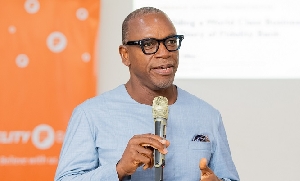 Edward Effah, founder of Fidelity Bank Ghana