Ghana Cocoa Board expects cocoa output to reach about 650,000 metric tonnes for the 2025/2026 crop season as government rolls out a new farmer pricing framework and prepares for a major shift in sector financing through the domestic debt market.
Chief Executive Dr Randy Abbey said production data suggest the country is on course to meet its projected target after several seasons of declining output linked to disease outbreaks, illegal mining, adverse weather conditions and financing constraints.
“We projected 650,000 for the 2025/2026 cocoa crop season,” Dr Abbey said in an interview, adding that available data indicate this target is within reach as the sector moves toward the light crop season.
The production recovery comes as government advances reforms to cocoa pricing aimed at improving farmer compensation while managing mounting financial pressures within the sector.
Dr Abbey said Cabinet has already approved a new pricing structure under which farmers will receive about 70% of the declared world market price, alongside periodic price reviews and separate pricing arrangements for main and light crop seasons.
He noted that the reforms are intended to protect farmer incomes amid volatility in global cocoa prices and rising production costs, although the policy will impose additional financial burdens on COCOBOD and other sector stakeholders.
“Government decided that it is going to give farmers about 70 percent of the declared world market price,” Dr. Abbey said. “The periodic reviews will help respond more quickly to changing market conditions.”
He said government’s efforts to improve farmer livelihoods will also require broader international cooperation, arguing that sustainability costs should not be borne disproportionately by producing countries and smallholder farmers.
Authorities are simultaneously pursuing a major financing restructuring for COCOBOD ahead of the 2026/2027 crop season, including plans to raise about US$1billion through cedi-denominated domestic bonds to finance cocoa purchases.
The proposed issuance will mark a departure from the offshore syndicated loan market that has financed cocoa purchases for more than three decades. Analysts view the programme as a key test of investor confidence in Ghana’s domestic debt market recovery following the 2022/2023 Domestic Debt Exchange Programme and COCOBOD’s own restructuring challenges.
“We are looking at funding the entire crop,” Dr. Abbey said during the Africa Cocoa Investment Forum in London earlier this month. “We believe that interest rates in Ghana now are at the right place for us to go into the market.”
The financing transition comes as COCOBOD continues to manage a debt burden estimated at about GH¢32billion while attempting to restore production growth and stabilise farmer incomes.
Ghana’s cocoa output had fallen sharply from a peak of about 1.04 million metric tonnes in the 2020/2021 season to around 531,000 tonnes in 2023/2024 before recovering to an estimated 700,000 tonnes in 2024/2025.
Speaking at the announcement of Ghana hosting the 2027 World Cocoa Foundation Partnership Meeting in Accra, Dr Abbey said the country will use the summit to push for fairer financing arrangements across the global cocoa value chain.
“Producing countries cannot carry this financial burden alone,” he said, warning that emerging sustainability and traceability requirements risk becoming “a tax on the poor” if international buyers and consuming countries do not assume a greater share of financing obligations.
The meeting, scheduled for March 16-18, 2027, will bring together governments, chocolate manufacturers, farmer groups, financial institutions and development partners under the theme ‘From Origin to Global Resilience’. Discussions are expected to focus on farmer livelihoods, climate resilience, disease management and supply security.
Dr Abbey said Ghana also intends using the event to attract investment into domestic cocoa processing, value addition and rehabilitation of farms affected by Cocoa Swollen Shoot Virus Disease.
Business News of Tuesday, 26 May 2026
Source: thebftonline.com
COCOBOD closer to 2025/26 harvest target of 650,000 metric tonnes
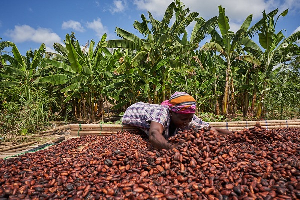 Cocoa is a key export commodity for Ghana