The Governor of the Bank of Ghana, Dr Johnson Pandit Asiama, has declared that Ghana is no longer merely adapting to global financial systems but is increasingly helping to shape them, as he outlined an ambitious vision for the future of financial markets.
Speaking at the ACI FMA World Congress 2026 in Accra in May 21, 2026, Dr Asiama said global finance is undergoing a structural transformation driven by digitalisation, integration, and the rising influence of emerging economies.
“Financial markets are being reshaped in real time. They are becoming more digital, more connected, and more shaped by emerging economies than they have ever been,” he said.
“Macroeconomic stability is not only good for financial market development; it is the infrastructure on which financial market development becomes possible,” Dr Asiama added.
BoG announces recovery in Ghana's gold reserves in April 2026
Recounting Ghana’s recent economic turbulence, the Governor noted that inflation had peaked at 54.1 percent in December 2022, while reserves were depleted and debt restructuring weighed heavily on confidence.
However, he said policy decisions over the past three years had restored stability, citing inflation of 3.4 percent as of April this year, reserves exceeding US$13.9 billion, and a 1,400 basis point reduction in the policy rate since early 2025.
“I share these numbers not in a spirit of celebration. Stability is not the achievement at which a financial system arrives; it is the foundation from which everything else becomes possible to build,” he said.
Dr Asiama also argued that the architecture of global finance is shifting away from traditional centres.
“The tools that are now reshaping global finance are no longer being built only in New York, London, or Frankfurt,” he said while pointing to innovations in instant payments, digital currencies, and AI-driven finance emerging across Africa, Asia, and Latin America.
The BoG Governor highlighted Ghana’s progress in digital financial infrastructure, describing payments as “no longer the back office of finance, but the front door.”
He cited mobile money interoperability, instant transfers, and the central bank’s digital currency pilot as key developments.
Touching on regulation, Dr Asiama stressed that “regulation is not a constraint on scale; it is the condition for scale,” arguing that credible frameworks enable rather than restrict innovation in digital finance.
He further called for deeper regional integration, stating that “markets that are not connected will not compete,” and advocating harmonised payment systems and cross-border fintech licensing across Africa.
Dr Asiama said Ghana is now “a contributor” to global financial market design, not merely a participant, urging policymakers to build systems that do not just respond to change but actively shape it.
MA
Business News of Thursday, 21 May 2026
Source: www.ghanaweb.com
Ghana contributing to design of new financial market era - BoG Governor
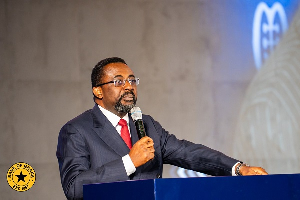 Dr Johnson Asiama, Bank of Ghana Governor