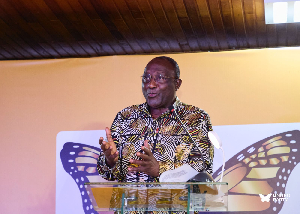
The Chief Executive Officer of the Ghana Association of Savings and Loans Companies, Tweneboah Kodua Boakye, says non-bank financial institutions continue to play a critical role in expanding access to credit, especially for customers who may not qualify for loans from traditional banks.
His comments come at a time when many traders within Ghana’s informal sector say access to credit remains expensive, despite improving macroeconomic conditions and falling benchmark interest rates.
According to him, the convenience and speed associated with non-bank lending partly explain why borrowing costs within the informal sector remain relatively high, even as interest rates in the formal banking sector ease.
“One of the things that you need to bear in mind has to do with cost, risk, and convenience. You will see that most customers of non-bank institutions are able to access credit immediately upon walking in, without even running an account there,” he explained.
Ghana's debt servicing may escalate after 2027 - Fitch Ratings
The Bank of Ghana recently reduced its policy rate to 14 percent, while the Ghana Reference Rate declined to 10.03 percent from 14.58 percent in February 2026. Average lending rates in the formal banking sector have also eased to about 19.7 percent.
However, during an interview on Citi Business News on Monday, May 11, 2026, many market women and petty traders who rely on microfinance institutions and other non-bank lenders for working capital said those reductions are yet to reflect in the informal lending space.
“If I go for a loan of 4,000 cedis, I’m asked to make a down payment of 700 cedis, with repayment expected within four to six months. And when you’re unable to pay, some lenders threaten you with police and court action,” a vegetable trader at Ashaiman Market is qouted to have said.
Some traders are also calling on the government to fast-track the proposed Women’s Development Bank to provide more affordable and flexible financing for women-led businesses.
Boakye further explained that although non-bank lending comes with higher operational costs, many institutions are gradually adopting technology-driven systems aimed at reducing costs and improving affordability over time.
The development highlights the broader challenge of ensuring that improving economic conditions and lower policy rates translate into affordable credit for businesses operating within Ghana’s vast informal economy.
SO/MA
LIVE: Accountability Series with Adjoa Obuobia Darko-Opoku
Business News of Monday, 11 May 2026
Source: www.ghanaweb.com
Non-bank institutions still vital for credit access - Kodua Boakye
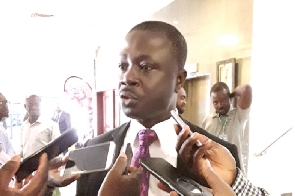 The CEO of Ghana Association of Savings and Loans Companies, Tweneboah Kodua