The Extractive Industry Workers’ Union Ghana (EIWUG) of the Ghana Federation of Labour has raised concerns over the government’s directive for major mining companies to transition to contract mining for surface operations by December 2026.
Thr group cautioned that the move could destabilize jobs and investment in the sector.
Speaking at a press conference on May 1, 2026, the union announced its decision to abstain from the national march to draw attention to what it described as a “major structural shift” in mining operations.
"The Extractive Industry Workers’ Union Ghana has observed with great concern the widespread media publications regarding a directive issued by the Government of Ghana to major mining companies, including Newmont, Zijin Golden Ridge Limited, and AngloGold Ashanti, to transition to contract mining for surface operations by December 2026," EIWUG said.
“This reported policy direction represents a major structural shift in mining operations, with far-reaching implications for job security, working conditions, collective bargaining rights, occupational safety, and the overall welfare of mine workers and their dependents,” it stated.
EIWUG warned that contract mining, if not properly regulated, could lead to the casualisation of labour, erosion of employment benefits, and weaker adherence to health and safety standards.
The union noted that past experiences in the industry have shown negative outcomes when subcontracting and third-party employment models dominate.
Free Zones CEO alleges sabotage in Akosombo sub-station fire
“Current practices increasingly rely on subcontracting and third-party employment models, which often result in job insecurity, lower compensation, and inconsistent labour standards,” the union stated.
The union further criticized the lack of clarity around the implementation framework and stakeholder engagement.
It urged the government and the Minerals Commission to consult organized labour, local communities, and industry stakeholders before rolling out such a significant policy.
“We believe that such a significant policy shift must be preceded by extensive consultation… guided by transparency, fairness, and a clear roadmap for implementation,” EIWUG stated.
EIWUG stressed that uncertainty in mining investment could harm Ghana’s economy, leading to job losses and reduced growth.
This, it said could undermine Ghana’s attractiveness to future investors.
While reaffirming support for local content and participation under LI 2431, EIWUG proposed a balanced approach to encourage local companies to form consortia and establish mining enterprises.
Strengthen monitoring and enforcement of local content obligations, allow international operators to continue under existing models while complying with localisation rules.
The union urged government to engage in “meaningful dialogue” to ensure that Ghana’s mining sector remains sustainable, competitive, and beneficial to workers and the wider economy.
SA
Business News of Friday, 1 May 2026
Source: www.ghanaweb.com
EIWUG warns government over contract mining policy
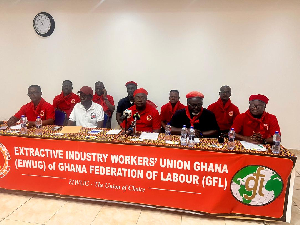 Leaders of the Extractive Industry Workers’ Union Ghana of GFL