Efforts to deepen Africa’s economic integration received a fresh boost this week as the Secretary-General of the African Continental Free Trade Area (AfCFTA), Wamkele Mene, held high-level talks with the Governor of the Bank of Ghana, Dr John Asiama, aimed at aligning financial systems with the continent’s ambitious trade agenda.
The meeting, which underscored the critical link between finance and trade, focused on practical steps to remove longstanding barriers to cross-border transactions, one of the key challenges hindering intra-African commerce. Central to the discussions was the urgent need to reduce the high cost of cross-border payments, which continues to limit the competitiveness of African businesses, particularly Small and Medium-Sized Enterprises (SMEs).
Both leaders acknowledged that despite the launch of the AfCFTA, inefficiencies in payment systems remain a major bottleneck. Businesses trading across borders often face delays, currency conversion challenges, and high transaction fees, all of which undermine the potential gains of a unified African market.
In response, the talks emphasized the importance of leveraging digital innovation to modernize financial infrastructure. Emerging technologies, including fintech solutions and digital payment platforms, were identified as critical tools in building faster, cheaper, and more transparent cross-border payment systems.
Such innovations, they noted, could significantly enhance financial inclusion and expand market access for SMEs, which form the backbone of many African economies.
Access to finance also featured prominently in the discussions. Both sides stressed that for the AfCFTA to deliver meaningful economic outcomes, businesses, especially smaller enterprises, must be able to secure affordable credit and financial services. Strengthening financial institutions and creating supportive policy frameworks were highlighted as essential steps in unlocking this potential.
The engagement further reflected a shared commitment to building a more integrated and efficient financial ecosystem across the continent. By aligning national financial systems with AfCFTA objectives, policymakers hope to accelerate intra-African trade, boost industrialisation, and create sustainable economic growth.
The meeting between the AfCFTA Secretariat and the Bank of Ghana signals a growing recognition that the success of Africa’s single market will depend not only on trade policies but also on the strength, efficiency, and inclusiveness of its financial systems among State Parties.
Namibia’s High Commissioner meet with AfCFTA Secretary-General to deepen collaboration efforts
The Secretary-General of the African Continental Free Trade Area (AfCFTA), H.E. Wamkele Mene, has held strategic talks with Namibia’s High Commissioner to Ghana, Ndiyakupi Nghituwamata, focusing on strengthening collaboration and unlocking new trade opportunities across the continent as part of a renewed push to accelerate Africa’s economic integration.
The high-level meeting comes at a critical moment as African countries intensify efforts to translate the AfCFTA framework from policy into tangible economic outcomes. Central to the discussions was the need to expand export opportunities, enhance intra-African trade, and fast-track the implementation of key provisions under the landmark trade agreement.
Both leaders emphasized that while the AfCFTA represents one of the most ambitious economic integration projects globally, its success will ultimately depend on the ability of member states to move beyond high-level commitments toward concrete, results-driven action. In this regard, the engagement highlighted the importance of building strong partnerships between countries to identify and develop viable trade corridors, reduce barriers, and create enabling environments for businesses to thrive.
The meeting also reinforced the critical role of intra-African trade as a driver of economic transformation and most importantly, the discussions reflected a shared commitment to shifting the narrative from dialogue to delivery as both sides agreed that practical implementation through coordinated policies, improved infrastructure, and private sector engagement is key to unlocking the full potential of the AfCFTA.
As the AfCFTA moves from negotiation to implementation, engagements with leaders of partner countries Namibia, signals growing momentum among African leaders to turn ambition into action.
The collaboration between the AfCFTA Secretariat and diplomatic missions like Namibia’s underscores a collective resolve to ensure that the agreement delivers real benefits to businesses, strengthens regional integration, and drives inclusive economic transformation across the continent.
Business News of Thursday, 30 April 2026
Source: thebftonline.com
AfCFTA, BoG to explore financial integration to boost intra-African trade
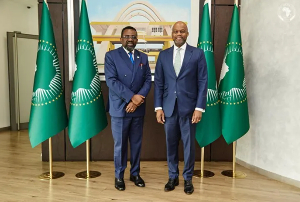 AfCFTA Secretary-General Wamkele Mene (R) and BoG Governor, Dr Asiama (L)