The Minister of State for Climate Change and Sustainability, Issifu Seidu, has reaffirmed its commitment to advancing global climate action and called for a stronger international cooperation to tackle the growing climate crisis globally.
The minister disclosed this at the 16th Vulnerable Twenty (V20) Ministerial Dialogue held on the sidelines of the IMF/World Bank Spring Meetings in Washington, D.C.
Addressing finance ministers, senior government officials, and development partners, the minister underscored that climate action is not only a moral obligation but also an economic necessity, particularly for vulnerable nations like Ghana, as well as other Countries in the sub-region that continue to bear the brunt of climate impacts despite contributing minimally to global emissions.
Delivering Ghana’s intervention on the theme “Prosperity, Stability, and Security in an Era of Planetary Instability,” Seidu conveyed warm greetings from His Excellency President John Dramani Mahama and the people of Ghana.
The minister highlighted the increasing frequency of extreme weather events such as droughts and floods, which are undermining development gains and deepening poverty among vulnerable populations in Ghana.

According to him, Ghana aligned itself with the V20’s urgent call for coordinated climate action and emphasized the importance of the V20–Development Finance Institutions (DFI), Compact as a critical mechanism for addressing debt challenges while unlocking much-needed climate finance.
Seidu commended initiatives by development partners, including the OPEC Fund for International Development, and called on development finance institutions to scale up support through concessional financing, longer repayment periods, and climate-responsive debt instruments.
He stressed that such measures are essential to enabling developing countries to adapt to climate impacts and transition to low-carbon economies.
Highlighting Ghana’s commitment to global climate goals, Seidu noted that methane reduction remains a key strategy in limiting global warming to 1.5°C.
The minister reiterated Ghana’s pledge under its Nationally Determined Contribution (NDC’s) within the Paris agreement framework to reduce methane emissions and accelerate clean energy transitions.
He further emphasized the need to prioritize climate justice, equity, and people-centred approaches in global climate policies and added that sustainable solutions must address the disproportionate burden faced by vulnerable countries like Ghana while ensuring inclusive development.

The minister outlined key areas requiring urgent global support, including concessional financing for climate adaptation and mitigation, debt relief for vulnerable economies, technology transfer and capacity building, and investments in climate-resilient infrastructure and green industrialization.
He acknowledged the support of the Green Climate Fund (GCF) in advancing Ghana’s renewable energy agenda, noting that such partnerships have already yielded tangible results.
However, he stressed the need for increased and sustained funding to help Ghana achieve its target of generating 30 percent of its electricity from renewable sources.
Reaffirming Ghana’s commitment to the V20 agenda, Seidu expressed optimism that strengthened partnerships and collective action would drive progress toward a more resilient and sustainable future.
“Together, we can achieve prosperity, stability, and security in the face of planetary instability,” he concluded.
Business News of Tuesday, 14 April 2026
Source: Office of Minister of State for Climate Change and Sustainability
Ghana calls for stronger global cooperation on climate action at V20 Ministerial Dialogue
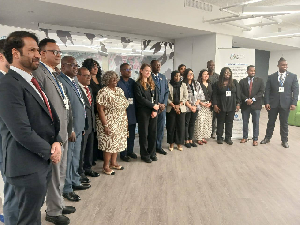 Officials at the 16th Vulnerable Twenty (V20) Ministerial Dialogue







Opinions