The domestic bond market has returned to growth in early 2026, with trading volumes rising and yields moving in the opposite direction.
However the recovery remains narrowly concentrated in government securities, with the corporate bond segment continuing to show limited depth in both value and volume terms.
Data from the Ghana Fixed Income Market (GFIM) indicate that total traded volume reached 114.39 billion in the first quarter of 2026, nearly doubling from 59.24 billion a year earlier. This resulted in trade values of GH¢103.57billion and GH¢48.19billion for the respective periods.
March activity alone rose to 35.8 billion, compared with 20.2 billion in March 2025. This resulted in a total transaction value of GH¢32.6billion versus GH¢16.3billion for the respective periods under consideration as liquidity and participation improved in the secondary market.
Market analysts say part of the recent momentum has been driven by renewed investor interest around government issuance.
As Apakan Securities noted in commentary on trade in the final week of March 2026: “Market activity rebounded sharply despite the holiday-shortened trading week, as anticipation around the newly issued 7-year bond drove renewed investor participation and lifted turnover to a four-week high”.
The newly issued seven-year bond, maturing in April 2033 and priced at a 12.5 percent coupon, raised GH¢2.78billion out of GH¢3.14billion in bids – pointing to moderate but improving investor demand.
Secondary market flows were concentrated along the short- to medium-term segment of the curve, with instruments such as the February 2027 and February 2032 bonds among the most actively traded as investors gradually rotate back into duration.
Yields have declined markedly across the curve, with medium- to long-term government bonds now trading between roughly 10 percent and 13 percent compared with levels above 22 percent a year earlier .
The compression has coincided with easing inflation over the period and improved macroeconomic sentiment, although modest concerns remain over the scarcity of alternative investable assets.
Corporates lag
Despite these gains on the market, the corporate bond segment remains marginal in both scale and activity. In March 2026, corporate securities recorded a traded volume of 595.4 million – a 38.32 decline over the 965.4 million recorded during the corresponding period of 2025, leaving corporates with just 1.66 percent of overall activity.
On a year-to-date basis, corporate bonds accounted for 2.43 billion in traded volume and GH¢2.44billion in value across 926 trades in the first quarter.
While this represents an increase from 965.4 million in volume and GH¢804.7million in value over the same period in 2025, the segment’s share of total market activity remains limited.
Trading within the corporate segment is also highly concentrated. In March 2026, the bulk of activity was driven by bonds issued by Ghana Cocoa Board, with its three-, four- and five-year instruments accounting for the overwhelming majority of corporate volumes.
The five-year COCOBOD bond alone recorded 440.6 million in traded volume (GH¢428.53million in value), while the three- and four-year notes contributed 76.1 million (GH¢77.67million in value) and 78.4 million (GH¢80.38million in value) respectively.
Other issuers saw minimal activity. A five-year bond issued by Bayport Financial recorded just 217,000 and GH¢221,432 in volume and value respectively for the quarter, while an Izwe Savings and Loans instrument traded 130,000 valued at GH¢142,937.5 – each with a single transaction. The limited breadth of participation continues to highlight narrow issuer base and low liquidity outside quasi-sovereign names.
Outstanding corporate securities further illustrate this concentration. As of March 2026, total corporate bonds stood at GH¢8.38billion with Ghana Cocoa Board accounting for GH¢7.33billion, or more than 85 percent of the total stock. The remainder is spread across a small number of financial institutions including Letshego Ghana Plc, Bayport Savings and Loans and Kasapreko Plc.
By contrast, government securities outstanding amounted to more than GH¢340billion, spanning Treasury bills and bonds across multiple tenors. Trading activity is similarly broad-based within the sovereign segment, with significant volumes recorded in Treasury bills and medium- to long-term bonds, particularly in the seven- to nine-year range.
The disparity demonstrates both demand- and supply-side constraints. On the demand side, investors continue to favour sovereign instruments supported by improved yields and stronger liquidity conditions. On the supply side, corporate issuers face higher borrowing costs and limited investor appetite, discouraging new issuance.
Secondary market dynamics reinforce this divergence. The number of trades across the entire market rose to 138,925 in the first quarter, up from 132,808 a year earlier – but corporate trades accounted for fewer than 1,000 of these on account of limited turnover and weak liquidity in that segment.
Business News of Thursday, 9 April 2026
Source: thebftonline.com
Bond market recovery leaves corporate issuers behind
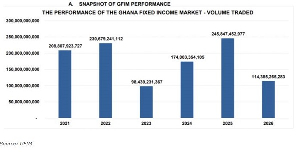 A snapshot of data from the Ghana Fixed Income Market




Entertainment