Bank of Ghana Governor Dr Johnson Pandit Asiama, on Sunday 5 April, participated in the Kwahu Business Forum Governor’s Roundtable session to discuss economic development and its impact on the business community.
Governor Asiama used the occasion to reflect on the country’s economic progress in 2025, highlighting the difficult policy decisions central banks face globally. Touching on inflation, which is of particular interest to the business community, Dr Asiama explained that the current low inflation rate had come at a huge cost to the central bank.
“The cedi is stable and under control,” he said, emphasising the unique position of central banks and the trade-offs influencing their decisions, adding: “The work we do is always about trade-offs… trying to strike the right balance.”
Dr Asiama explained that achieving the right balance between policies affecting growth and inflation is crucial. He acknowledged the positive impact of the strong macroeconomic performance in 2025 on the broader economy, but noted associated costs to the central bank.
“Last year was good but expensive for the central bank. It took us a lot of money to mop up excess liquidity and bring inflation down to 5.4 percent by December 2025,” he stated.
He further explained that the central bank’s monetary operations aimed to drain excess liquidity and while the cost was high in 2025, he is confident that 2026 will be different.
“If you look at where inflation was at the end of December 2024 and where it is now, it won’t involve the same level of resources to keep it low and stable going forward.”
The central bank Governor concluded by stating the importance of collaboration, assuring the business community that the central bank aims to strengthen the markets. “When banks are strong, they can give more credit.”
One of the central bank’s core mandates is to maintain economic stability through inflation to ensure that it remains low and stable. Stable inflation helps economies grow – and in establishing it central banks face difficult policy choices.
The choices are difficult because the tools used to mop up excess liquidity from the economy come with heavy cost, which often impairs the central bank balance sheet. In the Bank of Ghana’s case, BoG bills which commercial banks buy are costly – especially looking at the impact of policy rates on the issuance of such bills.
Other central banks and monetary authorities – like the US Federal Reserve and European Central Bank – face similar challenges.
A cursory look at the 2025 inflation rate shows that it dropped from 23.8% at end-December 2024 to 5.4% at end-December 2025.
Reducing inflation by such a magnitude couldn’t be cheap for the central bank – and at the last Monetary Policy Committee press briefing the Governor hinted that cost of Open Market Operations (the Bank’s activities on the market) went up significantly in 2025 because of the mopping up exercise.
But central banks can’t stand aloof and allow inflation to take a chunk off the disposable incomes of citizens because of cost. Whereas incomes may remain the same, every inch-up of inflation affects the population’s real incomes.
Looking ahead, Governor Asiama has assured that the 2025 OMO cost will not be repeated in 2026 because of the current low and stable inflation environment .
And the maths confirm this. In 2025 inflation was reduced by 18.4 percentage points – and with current inflation at below 4 percent there should not be so much difficulty in maintaining stability during 2026.
Business News of Wednesday, 8 April 2026
Source: thebftonline.com
Inflation fight costly but outlook eases for 2026 – BoG Governor
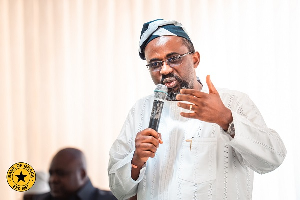 Dr Johnson Pandit Asiama is Bank of Ghana's Governor






Opinions