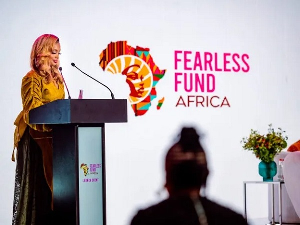
The launch of the Fearless Fund Africa in Ghana has renewed calls for targeted investment in women-led businesses, with its Co-founder and Chief Executive Officer, Arian Simone, citing new data from the World Economic Forum (WEF) which indicates that closing the gender financing gap could unlock up to US$316billion in additional gross domestic product (GDP) across the continent.
The Fund, which positions itself as a catalyst for inclusive economic growth through venture capital, loan programmes and grant initiatives, is focused on supporting under-resourced founders to scale and contribute meaningfully to economic development.
Speaking at the launch in Accra, Simone underscored the economic case for investing in women, describing African women entrepreneurs as “high-return” rather than “high-risk”.
She reaffirmed the Fund’s commitment to expanding access to capital for women across Africa.
She noted that Africa records the highest rate of female entrepreneurship globally, with one in three women either running a business or intending to start one. In Ghana, she added, women own nearly half of all businesses but continue to face structural barriers to growth.
“Despite their significant contribution to sectors such as agriculture, trade and the informal economy, women entrepreneurs remain largely excluded from formal financing systems,” she said.
Simone further estimated that women face a US$42billion financing gap and receive less than seven percent of total venture capital inflows, underscoring the scale of the disparity.
In response, the Fund has launched a microfinance initiative in Ghana aimed at providing small, high-impact loans tailored to women entrepreneurs.
This forms part of a broader financing model that has mobilised over US$240million globally to support under-resourced businesses that often struggle to access conventional credit due to restrictive or predatory lending conditions.
Beyond financing, the initiative includes a capacity-building component through its Get Venture Ready programme, designed to equip women entrepreneurs with the skills, networks and mentorship required to scale their businesses internationally.
This complements the Fund’s wider investment strategy, including a US$50million venture arm targeting women-of-colour-led businesses at pre-seed, seed and Series A stages, with investments already made in several companies worldwide.
In addition, its non-profit arm, the Fearless Foundation, has committed over US$5million in grants towards mentorship, education and innovation support to promote inclusive economic participation.
Delivering a keynote address on behalf of the Deputy Chief of Staff (Administration), Nana Oye Bampoe Addo, Juliana Ama Kplorfia highlighted the structural constraints limiting the growth of women-led enterprises.
“In Ghana, women own approximately 46.4 percent of businesses, one of the highest rates globally. However, many operate at a smaller scale due to limited access to capital, markets and investment-readiness support,” she said.
She noted that these constraints not only hinder business expansion but also suppress productivity, job creation and overall economic output.
Kplorfia described the entry of the Fearless Fund into Ghana as timely, pointing out that its targeted financing model—offering loans ranging from GH¢10,000 to GH¢30,000, alongside a GH¢100,000 pitch initiative—could help bridge the gap between participation and scale.
On the government side, she reiterated its commitment to strengthening the enterprise ecosystem through institutions such as the Microfinance and Small Loans Centre (MASLOC), the Venture Capital Trust Fund and the Ghana Enterprises Agency, all of which play key roles in expanding access to finance and business support.
She emphasised that closing the gender financing gap will require coordinated action among financial institutions, investors, development partners and policymakers.
This includes increased capital allocation to underserved entrepreneurs, the development of more inclusive financial products and sustained investment in business development support systems.
“The opportunity is clear. Women-led businesses are already driving economic activity across Ghana. With the right support, they can scale faster, create more jobs and contribute more significantly to national development,” she said.
Business News of Thursday, 26 March 2026
Source: thebftonline.com
Closing gender financing gap could add US$316 billion to Africa's GDP



Entertainment