Policy experts, bankers and industry leaders have called for deliberate efforts to translate the country’s macroeconomic stability into real-sector growth, job creation and productivity amid ongoing global shocks.
The call came at the Chartered Institute of Bankers Ghana’s (CIB Ghana) Post-MPC Policy Seminar, held under the theme ‘Balancing Stability and Growth: Interest Rates Impact in Geopolitical Shocks’. The event convened regulators, policymakers and private-sector representatives to assess the Bank of Ghana’s (BoG) latest monetary policy decisions and discuss strategies for sustaining economic performance.
The BoG recently reduced its benchmark interest rate by 150 basis points, bringing it down to 14 percent from 15.5 percent. The central bank cited sustained disinflation, improving domestic macroeconomic conditions and elevated real interest rates as key factors behind the move.
Headline inflation declined to 3.3 percent in February 2026 from 5.4 percent in December 2025 after peaking at 23.8 percent in December 2024, driven by easing food and non-food prices.
Economic activity has strengthened alongside the disinflation trend. Provisional data from the Ghana Statistical Service indicate that real GDP grew by 6 percent in 2025, up from 5.8 percent in 2024. Non-oil GDP expanded by 7.6 percent from 6.1 percent, buoyed by the services and agricultural sectors.
Externally, the country remains in a favourable position with the trade surplus widening to US$3.7billion in the first two months of 2026 from US$2.1billion a year earlier, supported by higher gold export earnings and modest import growth.
Gross international reserves increased to US$14.8billion, equivalent to 5.8 months of import cover and up from US$13.8billion at end-2025, while the cedi maintained relative stability against major currencies.
Despite these gains, experts warn that macroeconomic stability alone does not guarantee growth.
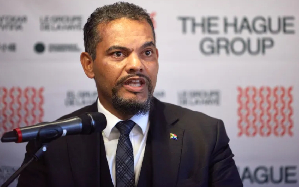
Dr Theo Acheampong, Technical Advisor to the Minister of Finance, emphasised that the challenge now is to translate stabilisation into broader economic growth which creates jobs and strengthens productivity.
Dr. Acheampong stressed that the disconnect between macroeconomic stability and real-sector performance must be addressed deliberately.
“Our consensus on the fiscal side is how you translate that stabilisation into two key things: broader economic growth that creates jobs and growth that is productivity-enhancing,” he explained adding that: “We need growth that impacts people’s livelihoods, strengthens productivity and builds domestic capacity”.
He also acknowledged structural weaknesses in the economy – particularly its vulnerability to recurring external shocks, which he described as the “new normal”.
To sustain growth beyond short-term stabilisation he stressed a need for long-term structural transformation, especially in agriculture and manufacturing, to build resilience and reduce import dependence.
On employment, he asserted government alone cannot provide jobs for everyone, stressing that the private sector must lead job creation with government providing an enabling environment for industries to absorb the workforce and reduce unemployment. Industry leaders echoed these concerns.
Industrialisation fund
President-Association of Ghana Industries (AGI) Kofi Nsiah-Opoku praised macroeconomic improvements but cautioned that benefits have yet to fully translate into increased demand and industrial growth.
He noted that although production costs are easing, consumer purchasing power remains weak – limiting sales and slowing industrial recovery.
He called for targetted policy interventions to support industrialisation, including the establishment of a dedicated industrialisation fund to provide long-term, affordable financing to manufacturers.
Nsiah-Opoku stressed that commercial banks are ill-suited to provide such financing becuse of their short-term funding structures.
He also warned that simultaneous fiscal and monetary tightening could risk economic stagnation, arguing instead for a more balanced approach that prioritises production, exports and sustainable growth.
Head of Emerging Affluent-Standard Chartered Bank, Harriet Osei-Mensah Owusu, ACIB noted that while there is increased appetite to lend, financial institutions remain cautious – balancing need to support economic activity with the imperative of safeguarding asset quality
She highlighted a shift toward deeper client engagement and closer monitoring of borrowers, saying banks are placing greater emphasis on the character and credibility of clients, recognising trust and ethical conduct as critical to loan performance.
President-Ghana Union of Traders’ Associations (GUTA) Clement Boateng clarified that declining inflation does not automatically reduce prices but slows the pace of increases.
He flagged challenges arising from the deployment of an AI-based system at ports for calculating duties and taxes, calling for greater stakeholder engagement to review the system.
Inclusive growth
The BoG Governor – in a speech read by Dr Philip Abradu-Otoo, Director of Research at the central bank – emphasised translating stabilisation into durable and inclusive growth.
He emphasised that lower policy rates should result in improved credit access for businesses of all sizes, including SMEs and traders.
He also highlighted the importance of continued policy coherence and regulatory support to make the banking sector a resilient driver of long-term economic transformation.
The seminar provided insights from the CIB pre-MPC survey, which engaged senior officials across Treasury, credit risk and other banking functions.
Robert Dzato, CEO-CIB Ghana, said the survey indicates that banks expect a gradual easing of policy rates, reflecting confidence in the economy and BoG’s approach to inflation management and macroeconomic stability.
Dzato reiterated that stability must be leveraged for growth through increased lending to the real sector, stronger coordination between fiscal and monetary authorities and structural reforms to boost productivity.
He said recommendations – including industrial financing mechanisms, value chain development and targetted skills export strategies – will be shared with policymakers to ensure sustainable growth and job creation.
Business News of Thursday, 26 March 2026
Source: thebftonline.com
Stability must translate into real-sector growth - Experts
 The call came at the Chartered Institute of Bankers Ghana’s (CIB Ghana) Post-MPC Policy Seminar



Entertainment