Global textile expert Rajesh Golani has called for stronger government intervention to stabilise and expand Ghana’s garment manufacturing sector, highlighting its potential to drive large-scale employment and industrial growth.
His remarks came during a high-profile working visit to Anowah Afrique Ltd, the largest wholly Ghanaian-owned garment manufacturing company, located within the Tema Free Zones Garment Village.
Drawing on more than three decades of international industry experience, Golani emphasised that Ghana possesses significant competitive advantages, including access to major global markets through existing free trade agreements with the United States, Europe, and regional African partners.
According to him, these opportunities position the country for rapid industrial expansion if supported by deliberate policy action focused on backward integration, subsidies, automation, and specialized workforce training.
“Right now, Ghana has free trade agreements with the US, Europe, across Africa, and in regional markets. This isn’t the time to watch orders pour in elsewhere; we just need to get started. We need that fire within ourselves, alongside government backing and collective expertise to support our industry. With automation, industrialisation support, and whatever else we can offer, this sector can thrive,” Golani stated.
A central focus of the visit was the anticipated impact of Ghana’s proposed 24-Hour Economy policy, which aims to create an enabling environment for businesses to thrive through the adoption of modern technology, improved access to finance, enhanced digitalisation, and expanded market access.
Golani noted that implementing a shift-based production system could significantly expand employment capacity within existing manufacturing facilities, citing Anowah Afrique as a prime example.
“This factory is restarting with a vision of 2,500 workers, creating more jobs for women, a great start for one shift alone. In a 24-hour economy, that's three shifts, meaning one small factory could employ up to 7,500 people. That's the holistic view of job creation we need,” he observed.
José A. Coffie, Deputy Chief Executive Officer of Anowah Afrique Ltd, on his part said, “With the introduction of the government's 24-hour economy policy, we are poised and ready to employ up to 7,500 vulnerable youth at our current facility.”
He further highlighted Ghana’s strategic advantage, noting the presence of the African Continental Free Trade Area (AfCFTA) Secretariat in Accra positions the country to strengthen its role in the global garment value chain.
Coffie emphasised the importance of leveraging this proximity to expand export capacity and increase the global market share of Ghanaian-made products.
Business News of Monday, 9 March 2026
Source: www.ghanaweb.com
Garment industry investment key to job creation in Ghana - Expert
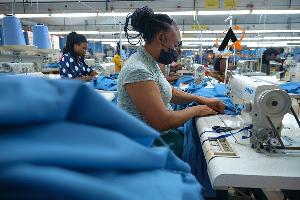 Ghana's proposed 24-Hour Economy aims to create an enabling environment for businesses