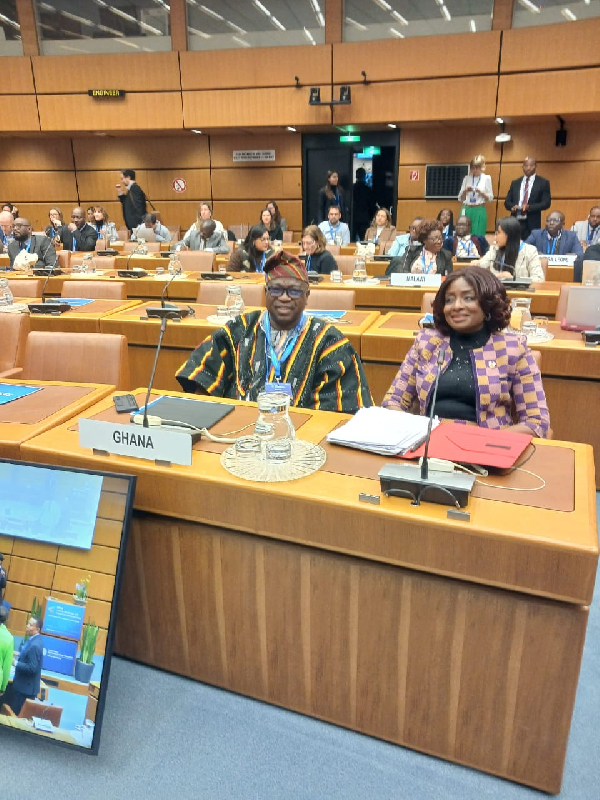
At the High-Level Opening Session of the UNIDO Climate Adaptation and Industrial Resilience Forum 2026, held at the Vienna International Centre on February 18, 2026, Ghana’s Minister of State for Climate Change and Sustainability, Seidu Issifu, delivered a compelling call for urgent, scaled-up climate finance to safeguard industrial systems and accelerate climate-resilient development.
Addressing ministers, ambassadors, and distinguished delegates from around the world, Issifu framed the global climate crisis as not only an environmental challenge, but also an industrial and economic one.
He emphasised that the widening adaptation finance gap poses a direct threat to productivity, competitiveness, and stability particularly for developing economies.
“We gather in Vienna at a pivotal moment,” the minister noted, highlighting escalating droughts, floods, and rising temperatures that are undermining development gains.
For Ghana and many countries across Africa, adaptation is not a secondary agenda. “It is central to development, stability, and competitiveness and increasingly, it is central to industrial policy.”
Climate Adaptation as Industrial Strategy
Ghana is already experiencing the consequences of climate change, with increasing shocks disrupting infrastructure, supply chains, and livelihoods.
Citing recent data indicating that approximately 13 million Ghanaians face food insecurity, Issifu underscored the interconnectedness of climate impacts and economic systems.
Under Ghana’s evolving development framework, including its 24-Hour Economy agenda, the country is pursuing productivity and industrial expansion while embedding resilience into its economic architecture.
“We need infrastructure that does not fail, logistics that do not collapse, and value chains that can recover rapidly when hazards strike,” he said.
To support this vision, Ghana has taken decisive institutional steps. In 2025, the government established the Office of the Minister of State for Climate Change and Sustainability under the Presidency, reinforcing high-level coordination and strategic leadership on climate action.
Beyond national coordination, Ghana is advancing two major governance innovations:
• The establishment of a Climate Change and Sustainability Hub as a national center of excellence to strengthen climate intelligence, investment matchmaking, innovation, and evidence-based planning.
• The institutionalization of Climate Change and Sustainability Units across all Municipal and District Assemblies, embedding adaptation into local planning, budgeting, and implementation.
In a candid reflection, Issifu acknowledged growing skepticism around the effectiveness of annual Conferences of Parties (COP), noting that many stakeholders question whether global commitments are translating into tangible outcomes. Ghana’s position, he stated, is clear: COP30 commitments must now be converted into actionable, scalable solutions particularly for industrial resilience in vulnerable economies.
To achieve this, he called for:
• Scaled-up adaptation finance for industry, including grants, concessional loans, and blended finance mechanisms.
• Technology transfer and innovation partnerships to enable climate-smart manufacturing.
• Policy frameworks that incentivize green and resilient investments.
• Debt relief and innovative financing instruments to unlock fiscal space.
• Enhanced capacity support to enable developing economies to access climate finance effectively.
The minister stressed that climate justice and equitable financing must remain central to global discourse.
“Africa contributes minimally to global emissions but withstands the worst of climate impacts,” he noted, emphasising the need for financing structures that reflect this imbalance.
Seidu Issifu commended UNIDO’s work in eco-industrial parks, MSME support, and resilient value chains, describing it as a practical model for climate-smart industrialization.
He emphasised that private sector engagement will be critical to scaling resilient production systems and unlocking investment.
“Industry is not separate from society it is the engine of livelihoods,” he remarked.
When production halts, incomes decline; when supply chains break, inflation rises; when infrastructure fails, services collapse. Embedding resilience into industrial strategies, he argued, offers an opportunity to create green jobs, strengthen competitiveness, and build sustainable economies.
Closing his address, Issifu urged governments, multilateral institutions, and industry leaders to move decisively from pledges to delivery.
“Let us turn COP30 promises into climate-resilient industries, green jobs, and a sustainable future,” he concluded.
With sustained political will, equitable financing, and strong international partnerships, Ghana believes Africa can leapfrog toward a low-carbon, climate-resilient industrial transformation, one that creates jobs, reduces poverty, and drives inclusive growth.
As the Forum continues in Vienna, Ghana’s message is clear: adaptation finance is not merely a climate issue, it is a development imperative, an industrial strategy, and a foundation for long-term economic resilience.
Business News of Wednesday, 18 February 2026
Source: Cedric Dzelu, Contributor
Ghana calls for scaled-up climate finance to build resilient industries
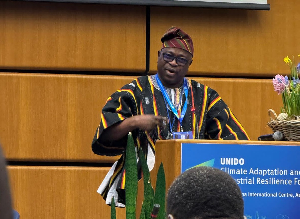 Minister Seidu Issifu speaking at the event