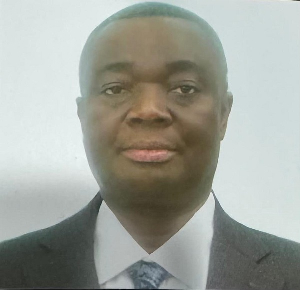
The Chief Investment Officer of Axis Pension Trust, Peter Bawuah has admonished government to use this period of economic stability for a radical portfolio diversification while ensuring the financial system fuels the real sector to build lasting resilience.
Speaking at 4th Annual Forcast Dinner and Charter Recognition Ceremony organised by the Chartered Financial Analyst (CFA) Society Ghana in Accra, the Chartered Financial Analyst (CFA) urged government to leverage the economic strength to “industrialise our economy” and reduce import dependency – encouraging government to implement policies and allocate capital strategically to reshape the economy’s productive base.
“We are currently too reliant on external markets. Our country is import-oriented. It’s not sustainable. We need to put in place policies that are going to help reduce our dependence,” he emphasised.
Mr. Bawuah identified agriculture, aquaculture, agro-processing, ICT and domestic manufacturing as the sectors requiring investment to build a resilient economy.
“This is the time to use these strong positions and actually diversify our economy. Stabilising our currency by pumping dollars into the economy – I don’t know how sustainable that is,” he stated.
Mr. Bawuah further warned investors that the era of easy, broad-market gains is over and emphasised an urgent need for selectivity in a world of overvaluations, pointing to the S&P 500 trading at 200 percent of US GDP – a level that signals severe overvaluation according to what he termed the “Warren Buffett Indicator”.
“We are not in a situation where a rising tide is going to lift all boats. Not every asset class or every sector is going to do well. This is where active management and deliberate diversification come in handy,” Mr. Bawuah warned.
He argued that the imperative is a disciplined and tactical diversification strategy spanning sectors, geographies and asset classes. “Being an index investor, it’s not the time for that. You have to be selective. You need to know what you’re getting yourself into,” he cautioned.
The Head of Macroeconomic Research, Investor Relations & ESG at GCB Bank, Courage Kwesi Boti, also echoed similar caution in providing an analysis of “extraordinary measures” underpinning the Ghanaian economic recovery.
He argued that the drop in inflation was achieved through unsustainable means, including the central bank’s costly sterilisation of liquidity and government’s suspension of GH¢68billion in validated payables.
“The question is: how long will they continue posting such losses at the expense of heavy sterilisation?” Mr. Boti quizzed, alluding to some potential Bank of Ghana losses – noting its US$214 million loss in gold trading reported by the IMF.
He warned that these are one-off interventions, not structural fixes: predicting that inflation will likely climb back toward the 8 percent band by mid-year, interest rates will plateau and government’s planned US$64billion deficit financing could crowd out the private sector and re-ignite pressures if mismanaged.
“A lot of it is cold and hot air,” he said, while endorsing the central bank’s liquidation of half its gold holdings to bolster hard currency reserves.
The Managing Director of Ghana Stock Exchange (GSE), Abena Amoah, highlighted constraints facing the real economy – pointing out that despite the lower policy rate, credit transmission to productive sectors remains weak with banks still risk-averse due to legacy non-performing loans.
“The cost of capital for the small and medium-sized enterprises is still prohibitively high,” Ms. Amoah noted, calling for companies to come and raise patient capital for growth at the exchange.
She emphasised that if government’s big infrastructure push is not carefully synchronised with private sector access to funding, “we risk a stifled private sector”.
She concurred with the call for diversification, stressing that “true industrialisation requires capital to flow to factories, agribusiness and agro-processing companies and farms, not just to service debt and imports”.
Business News of Wednesday, 4 February 2026
Source: thebftonline.com
Diversify economy to build resilience – Peter Bawuah to government
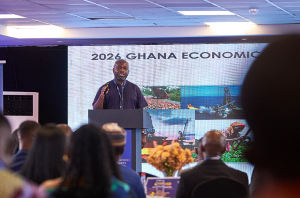 The Chief Investment Officer of Axis Pension Trust, Peter Bawuah




Entertainment