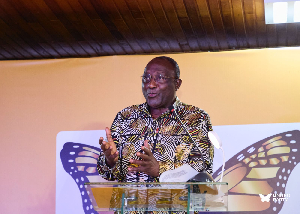
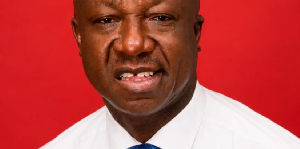
The Minister of Finance, Dr Cassiel Ato Forson, has thrown his weight behind the West Africa Food System Resilience Project (FSRP) as Ghana intensifies efforts to achieve rice self-sufficiency.
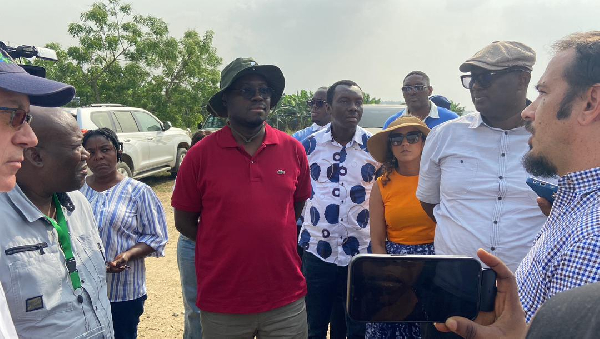
He was accompanied by senior officials of the World Bank and FSRP on a working visit to the Kpong Irrigation Scheme (KIS) and Golden Exotic Limited in Asutsuare and Akuse in the Eastern and Greater Accra Regions on Friday, January 30, 2026.
The visit formed part of government’s strategy to scale up irrigated agriculture and reduce Ghana’s dependence on imported rice through targeted investments under the World Bank-funded FSRP.
The FSRP is currently rehabilitating and modernising the Kpong Irrigation Scheme, which serves farming communities around Akuse and Asutsuare.
The project includes; Rehabilitation of irrigation and drainage infrastructure
Installation of automation and instrumentation systems for efficient water management
Rehabilitation of access roads
Improved management systems for the scheme
$22.6m World Bank support to boost Ghana's food security - Ato Forson
Rehabilitation works are about 75 percent complete, while installation of automation equipment stands at 30 percent. When fully operational, the scheme is expected to irrigate approximately 4,040 hectares of farmland.
The project is being implemented at a cost of US$22.6 million, funded by the World Bank.
Speaking during the tour, Dr Forson said the World Bank loan under FSRP would significantly strengthen Ghana’s food security and address long-standing structural challenges in the agricultural sector.
“Let me thank the World Bank for the assistance and for allocating this loan facility to the Government of Ghana to enable us to develop our agriculture sector. This is a sector that has struggled over the years, and this support will go a long way,” he said.
The finance minister added that Ghana could no longer rely heavily on food imports.
“We can’t always be importing food into our country. From what I’ve seen, I’m encouraged that with the right investments, we can be self-sufficient and the food insecurity challenges we face will be a thing of the past,” he noted.
Addressing concerns from rice farmers about access to markets, Dr Forson assured them that the School Feeding Programme had been directed to procure only made-in-Ghana food products.
He also announced that the National Buffer Stock Company (NABCO) had been retooled and would receive budgetary allocations to buy produce from local farmers, while new storage silos would be constructed to reduce post-harvest losses.
“These measures will guarantee markets for farmers, encourage higher production and reduce post-harvest losses,” he stated.
The World Bank Country Director for Ghana, Liberia and Sierra Leone, Robert Taliercio, reaffirmed the Bank’s commitment to Ghana’s agricultural transformation agenda.
He noted that agriculture contributes about 20 percent of Ghana’s GDP and provides employment for over one-third of the population, making it a critical pillar of the economy.
“Agriculture is a very important sector for Ghana. Infrastructure remains a major challenge, and despite these constraints, the World Bank remains committed to supporting Ghana, particularly in closing infrastructure gaps,” Taliercio said.
He disclosed that discussions were ongoing between the World Bank and government on a US$1 billion agricultural support programme to expand irrigation, improve rural roads, support export-oriented crops and boost productivity.
Under the FSRP rice self-sufficiency model, Ghana is targeting the development of at least 100,000 hectares of irrigated land, organised into 5,000–10,000-hectare production enclaves.
The Kpong Irrigation Scheme currently benefits about 2,000 smallholder rice farmers, as well as Golden Exotic Limited, the largest organic banana producer and exporter in Africa.
The scheme also supplies water to aquaculture companies producing tilapia and catfish.
The West Africa Food System Resilience Project (FSRP) is a Government of Ghana initiative funded by the World Bank, coordinated by ECOWAS and implemented in eight West African countries. In Ghana, the project is being implemented by the Ministry of Food and Agriculture.
AM
#TrendingGH: Watch some Ghanaians react to Kotoka International Airport renaming:
Business News of Tuesday, 3 February 2026
Source: www.ghanaweb.com
Finance Minister, World Bank back FSRP to drive food self-sufficiency
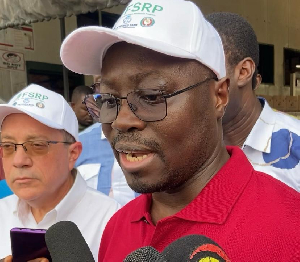 The visit formed part of government’s strategy to scale up irrigated agriculture