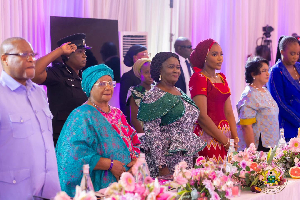
The Executive Chair-Africa Governance Centre (AGC), Benedicta Lasi, has cautioned that Africa risks missing out on China’s new zero-tariff regime for least-developed countries (LDCs) if governments fail to strengthen production, standards and export capacity.
She warned that “zero tariffs do not automatically mean exports” – stressing that without stronger economic fundamentals, the continent could face a situation where “zero tariffs will simply become zero exports”.
Madam Lasi said Africa stands at a critical point as global economic dynamics – ranging from supply chain shifts to energy transitions and rising geopolitical competition – reshape development pathways.
Against this backdrop, she argued that China’s partnership with Africa, particularly Ghana, remains central but must evolve to meet emerging economic realities.
“The next decade must shift from inputs to outcomes; from projects to productivity; from infrastructure to industrial capacity; from aid to AfCFTA-driven competitiveness,” she noted.
She said this at a press briefing addressed by Chinese Ambassador Tong Defa in Accra.
She observed that while the last two decades of China–Africa cooperation has delivered significant infrastructure – roads, rail, energy and digital systems – the continent must now focus on translating these investments into industrial output and competitive exports.
“Africa does not need partners who admire our potential; we need partners who help us convert potential into production, production into exports and exports into jobs,” she stated.
According to her, Africa’s future development will be shaped by three defining realities: the urgent need for industrialisation, transformative potential of the African Continental Free Trade Area (AfCFTA) and the importance of strong governance and institutions.
“No nation has created prosperity by exporting raw materials forever. China’s own development proves this,” she said, adding that investment cannot thrive “where regulation is weak, bureaucracy is slow or policy signals are inconsistent”.
Madam Lasi emphasised that African countries must enhance capacity across the value chain if they are to benefit meaningfully.
She outlined six priority areas: local manufacturing, meeting global standards, improving logistics and ports, expanding storage and cold-chain systems, strengthening export finance and coordinating regionally rather than acting in isolation. Failure to act decisively, she stressed, would mean the continent “must confront the uncomfortable truth” of being unable to take advantage of the preferential access China now offers.
She further called for a deeper, more structural approach to China-Africa cooperation. “Africa does not need more short-term projects. We need something deeper, more structural, more transformational,” she said.
She urged China to support the continent in building industrial zones that ensure African products enter Chinese markets competitively, establishing technical standards laboratories, developing skills pipelines and supporting digital governance systems which reduce corruption and enhance investor confidence.
“If the last 20 years were defined by infrastructure, the next 20 must be defined by industrialisation and shared prosperity,” Ms. Lasi said – underscoring that the next breakthroughs in China–Africa relations will come from industrial development rather than more infrastructure.
Ghana in focus
The Africa-China Centre for Policy and Advisory also noted in a publication that to maximise the benefits of China’s zero-tariff policy, Ghana should consider adopting data-driven reciprocity – basing tariff decisions on empirical trade data to identify low-risk product lines.
It further suggests that the country should: “Negotiate industrial partnerships and tie tariff concessions to Chinese commitments in local manufacturing, skills transfer and green investment; “Safeguard sensitive sectors: maintain protective measures for industries critical to job creation and value addition; Enhance export capacity: expand export financing, logistics and certification support for Ghanaian firms targeting the Chinese market; And strengthen institutional coordination to align efforts across Ghana export promotion authority, ministry of trade and industries, Ghana revenue authority, etc., thus ensuring coherent trade policy implementation.
ACCPA noted: “China’s zero-tariff initiative is more than a diplomatic gesture – it is a strategic opening that could redefine Ghana’s trade and industrial future. However, the ultimate outcome depends on how Ghana manages reciprocity.”
It added that: “A well-calibrated, data-driven approach can transform potential risks into opportunities for structural transformation. Ghana must act not as a passive recipient of goodwill but as an active partner shaping the terms of engagement. With strategic reciprocity, the country can turn this policy into a cornerstone of its 24-Hour Economy, advancing inclusive growth, industrial resilience and sustainable prosperity”.
In June 2025 China unveiled a landmark decision to grant zero-tariff access for all 53 African countries with which it maintains diplomatic relations, deepening commitment to South–South cooperation through trade rather than aid.
Business News of Friday, 16 January 2026
Source: thebftonline.com
Zero tariffs with China could become zero exports without industrial capacity - AGC
 Executive Chair-Africa Governance Centre (AGC), Benedicta Lasi