The Ghana Association of Banks (GAB) is intensifying an industry-wide push to strengthen ethical standards and curb fraud, insisting that breaches of integrity – particularly involving staff – pose a growing threat to public confidence in the banking sector.
The Chief Executive Officer of the association, John Awuah, said the renewed focus reflects a fundamental reality of banking: trust underpins the industry’s very existence.
“As banks, our currency of trade is trust. If we lose the trust of the banking public, we have lost our business,” he stated.
Speaking at a board-level ethics training for directors of member banks in Accra, he stressed that the initiative forms part of a sustained effort to reinforce integrity, improve conduct and strengthen internal controls across institutions.
Central to the drive is a renewed emphasis on leadership accountability, with Awuah noting that ethical conduct must be driven from the highest levels of governance.
“The tone we set at the top is what the people on the ground hear,” he noted, cautioning that weak ethical leadership risks permeating entire organisations.
The training that brought together board chairs and directors marks the beginning of a broader programme that will unfold in the coming weeks, including a nationwide public awareness campaign on fraud and integrity, alongside certification schemes for bank staff.
Ketu South residents raise concern over rejection of pesewa coins
Under the programme, all employees across the banking sector will be required to undergo annual ethics certification through an online training platform in collaboration with the Chartered Institute of Bankers.
A complementary fraud-focused certification will also be rolled out to ensure that staff at all levels – not only frontline personnel – are equipped to detect and prevent unethical practices.
“We want everybody to be in the same boat when it comes to assurance of integrity,” Awuah said.
Fraud trends
The intensified focus comes amid concerns over fraud trends highlighted by the Bank of Ghana, which point to increasing staff involvement in fraudulent activities.
For instance, the central bank’s 2024 Fraud Report shows that total reported fraud cases rose by 5 percent to 16,733 across banks, specialised deposit-taking institutions (SDIs) and payment service providers (PSPs), while the total value at risk increased by 13 percent to about GH¢99 million.
The report further indicates that the number of staff implicated in fraud cases rose by 33 percent, from 274 in 2023 to 365 in 2024, reflecting concerns about internal control and oversight within financial institutions.
Awuah described the development as deeply troubling, stressing that “one fraud is one too many” for the industry.
In response, banks are stepping up enforcement measures, including dismissals, prosecutions and plans to publicly expose individuals found culpable after due process.
“We need to make the public aware that there are consequences,” he said, adding that the industry must do more to communicate actions taken against wrongdoing.
Beyond fraud, he pointed to broader societal challenges, noting a general decline in moral standards but insisting that banks must remain insulated from such pressures.
“We have to do everything to wean the industry off any semblance of moral breakdown,” he said, warning that unethical practices such as inducements in lending decisions undermine both institutional credibility and risk management.
The ethics drive also intersects with wider sector challenges, particularly elevated non-performing loans (NPLs), which remain significantly above regional benchmarks.
Awuah explained that while easing interest rates are expected to improve loan affordability and reduce default risks, structural bottlenecks within the legal and regulatory system continue to hinder credit recovery.
He cited delays in the courts and operational inefficiencies within institutions such as the Lands Commission and other regulatory bodies as constraints on effective enforcement of credit agreements.
“We cannot lead economically and have default rates around 19 percent when other jurisdictions are doing 4 to 6 percent,” he lamented.
He stressed that strengthening ethics, governance and accountability across the banking system is critical to reducing risk, improving lending conditions and supporting economic growth.
GAB President Kwamina Asomaning, in a remark read on his behalf by Lawrence Sackey, reiterated that ethics remains the bedrock of trust in the banking system, noting that discussions had reinforced the practical importance of fiduciary duty, sound governance and effective conflict-of-interest management in shaping institutional credibility.
He urged board members to translate insights from the training into leadership practice, adding that the long-term strength of the banking sector depends not only on financial performance but also on sustained ethical discipline.
Business News of Friday, 17 April 2026
Source: thebftonline.com
We cannot 'survive' without ethical practices - GAB tells banks
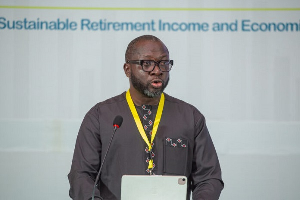 John Awuah is the CEO of the Ghana Association of Banks




Entertainment